

Lower airflow is often expected to improve the capture of small particles because they remain in the filter medium longer and Brownian diffusion becomes more effective. Yet a laboratory or production test may sometimes report lower efficiency at a low airflow point.
That result should not immediately be explained as a special filtration mechanism. In many cases, the first question is not “Why did the filter become worse?” but “Is the low-flow result being measured under valid and comparable conditions?”
This article presents a practical order of investigation.
Start with the Quantity Being Compared
Start with the Quantity Being Compared
Filtration efficiency is not a single material constant. It depends on several test conditions, bao gồm:
- particle size or particle-size distribution;
- filter medium velocity and filter face velocity;
- aerosol material and charge state;
- filter conditioning and electrostatic state;
- temperature and relative humidity;
- upstream concentration and sampling duration; Và
- the condition of the filter and sealing system.
A comparison is meaningful only when these variables are controlled. “500 m³/h efficiency” and “1,000 m³/h efficiency” cannot be interpreted correctly without also knowing the filter area, the particle channel being compared, and the test method.
What Filtration Theory Actually Predicts
What Filtration Theory Actually Predicts
Mechanical fibrous filtration is mainly governed by diffusion, interception, and inertial impaction.
- Diffusion is most important for very small particles. Lower velocity generally gives these particles more time to move away from the streamline and contact a fibre.
- Interception becomes more important as particle size increases and a particle following a streamline passes within one particle radius of a fibre.
- Inertial impaction becomes more important for larger particles and higher velocities because the particles are less able to follow the air around a fibre.
The MPPS occurs near the minimum of the combined efficiency curve, where no capture mechanism is especially strong. Changing the velocity can change both the minimum efficiency and the particle size at which that minimum occurs.
This does not mean that low velocity creates a new “streamline bypass” mechanism. Flow around fibres is normally laminar at filtration-scale conditions. A measured decrease at low airflow must therefore be demonstrated with controlled, size-resolved data rather than assumed from a verbal explanation.
First Check: Is the Test Point Within the Valid Range?
First Check: Is the Test Point Within the Valid Range?
Every test system has a validated operating range. At the low end of that range, several control and measurement limits can become more influential:
- airflow control resolution;
- aerosol mixing and spatial uniformity;
- response time between upstream and downstream sampling;
- particle losses in sampling tubes;
- detector background and zero counts; Và
- the number of particles counted during the sampling period.
If the requested airflow is below the validated range for the duct, nozzle, flow meter, máy tạo khí dung, or sampling arrangement, the result should be treated as a diagnostic result rather than a standards result.
Common Causes of an Apparent Efficiency Drop at Low Airflow
Common Causes of an Apparent Efficiency Drop at Low Airflow
1. Bypass Leakage Becomes a Larger Fraction of the Total Flow
1. Bypass Leakage Becomes a Larger Fraction of the Total Flow
A small fixed leak through a gasket, clamp, fixture, or test duct may be difficult to see at a high total airflow. At low airflow, the same leakage flow represents a larger fraction of the total and can produce an apparent decrease in efficiency.
Check the filter perimeter, fixture blanking plates, upstream/downstream separation, sample ports, and any temporary adapters. A blank-plate leak test is often more informative than repeating the same filter measurement.
2. Upstream Aerosol Is Not Stable or Uniform
2. Upstream Aerosol Is Not Stable or Uniform
At a lower duct velocity, the aerosol generator setting, mixing length, and injection position may no longer produce the same stable challenge at the filter face. If upstream and downstream concentrations are measured at different times, concentration drift can appear as a change in penetration.
Verify temporal stability, spatial uniformity, and the delay between the two sampling paths. Do not assume that a generator setting validated at one airflow remains valid at every lower airflow.
3. Particle Counts Are Too Low for Reliable Statistics
3. Particle Counts Are Too Low for Reliable Statistics
High-efficiency filters produce very few downstream counts. A short sample with only a small number of events has high statistical uncertainty. Background particles, residual particles in tubing, or one intermittent leak can then dominate the calculated efficiency.
Increase the sampling time where the method permits, confirm the upstream concentration is within the instrument’s usable range, perform a zero/background check, and report penetration with its counting basis rather than relying only on a rounded efficiency percentage.
4. The Two Measurements Are Not Comparing the Same Particle Size
4. The Two Measurements Are Not Comparing the Same Particle Size
If the test aerosol distribution changes with generator setting or flow, a broad particle channel can be weighted differently at different test points. A reported “0.3 μm efficiency” may also refer to a threshold channel rather than a narrow, size-resolved measurement.
For mechanism analysis, use size-resolved efficiency curves. Compare the same channel definitions, bình xịt, neutralization state, and instrument settings at every airflow.
5. Sampling and Transport Effects Have Changed
5. Sampling and Transport Effects Have Changed
Sampling flow, tubing length, bends, probe orientation, and transport delay should remain controlled. Probe-related bias is usually less severe for submicrometre particles than for large particles, but it should not be ignored when the main duct velocity changes substantially.
Confirm the particle counter sample flow, dilution ratio, tube condition, and upstream/downstream path equivalence.
6. The Filter or Medium Changed Between Tests
6. The Filter or Medium Changed Between Tests
Electret media can be affected by aerosol loading, solvents, temperature, độ ẩm, and conditioning history. Mechanical media can also change after handling, niêm phong, or repeated installation. A flow sequence that always runs from high to low can therefore confuse time-dependent change with airflow-dependent change.
Use a randomized or repeated sequence—for example low → high → low—and include a reference filter to separate system drift from sample change.
When the Result May Be a Real Media Effect
When the Result May Be a Real Media Effect
After the system checks pass, velocity-dependent filter behaviour can be investigated. The correct method is to measure fractional efficiency over a particle-size range at several controlled medium velocities.
The analysis should show:
- the complete efficiency-versus-particle-size curve;
- the corresponding MPPS at each velocity;
- repeat measurements and uncertainty;
- pressure drop at each test point; Và
- whether the medium is mechanical, charged, membrane-based, or a composite.
A real change can then be linked to the balance of diffusion, interception, impaction, and electrostatic capture. It should not be attributed simply to “laminar streamlines passing through large pores.”
Recommended Troubleshooting Sequence
Recommended Troubleshooting Sequence
- Repeat the low-flow point without changing the filter installation.
- Perform a system leak or blank-plate check.
- Verify the actual airflow and pressure sensors at the low point.
- Confirm upstream aerosol stability and spatial uniformity.
- Check background counts, thời gian lấy mẫu, sự tập trung, and particle-counter limits.
- Repeat with a stable reference filter.
- Run a low → high → low sequence.
- If the effect remains, measure a size-resolved efficiency curve at each velocity.
This order prevents a measurement-system problem from being turned into an unsupported explanation about filter physics.
How SCPUR Supports Low-Flow Investigation
How SCPUR Supports Low-Flow Investigation
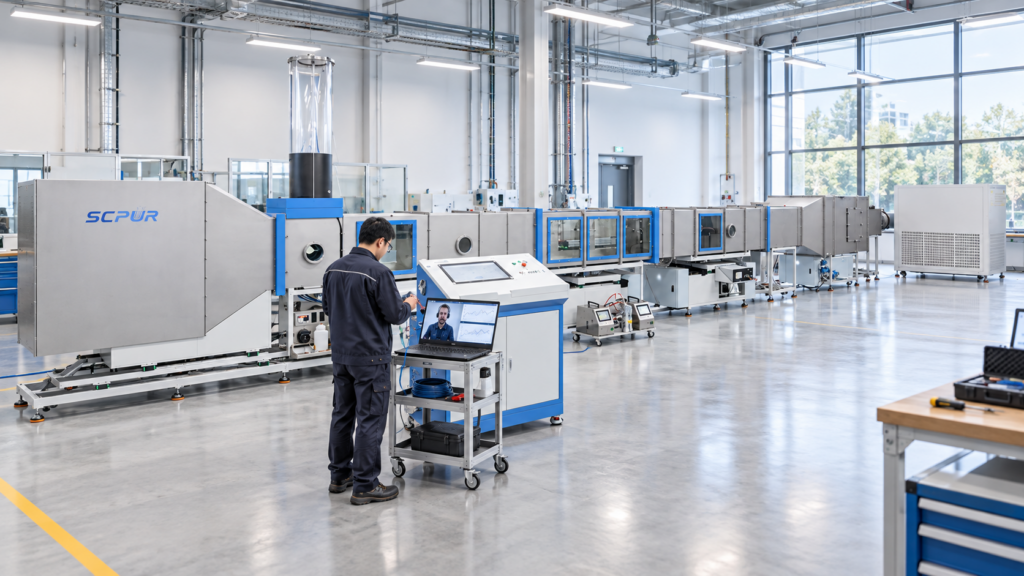
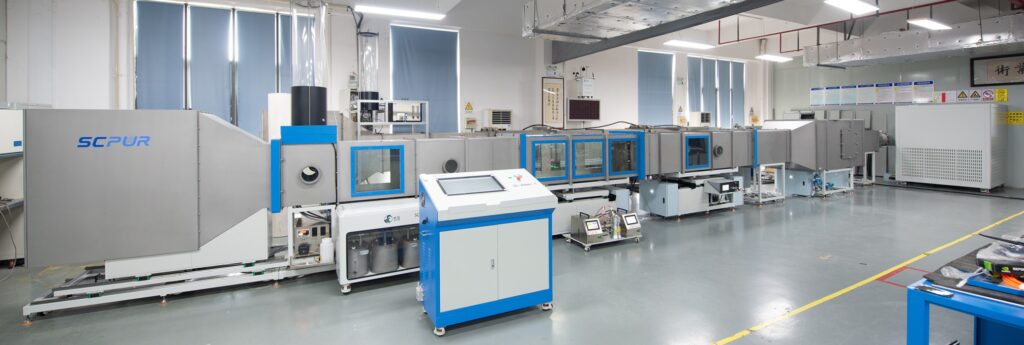
SCPUR test systems are configured around defined airflow, particle-size, sự tập trung, and filter-size ranges. For filter media or small filter elements, cái SC-FT-1406D-Pro provides controlled efficiency and resistance testing with oil- or salt-based aerosol configurations.
For a low-airflow anomaly, the useful output is not only a pass/fail value. It is a repeatable test record that helps separate airflow control, tạo khí dung, lấy mẫu, leakage, and the filter itself.