

Air cleaners used with engines and compressors must protect internal components from airborne dust while maintaining the airflow required for operation.
ISO 5011:2025 provides standardized laboratory procedures for comparing the performance of inlet air cleaning equipment used in automotive and industrial applications. It establishes test conditions, equipment requirements, measurement procedures and reporting requirements for several important characteristics:
- Airflow restriction or differential pressure
- Dust collection efficiency
- Dust capacity
- Oil carry-over from oil-bath air cleaners
This article explains the main ISO 5011 test methods, the meaning of the reported results and the limitations that should be considered when applying laboratory data to field operation.
What Is ISO 5011:2025?
The full title of the current standard is:
ISO 5011:2025 — Inlet air cleaning equipment for internal combustion engines and compressors — Performance testing
The 2025 edition is the fifth edition of the standard and replaces ISO 5011:2020.
Its purpose is to provide uniform laboratory methods that allow air cleaners to be compared under controlled and repeatable conditions. It applies to inlet air cleaning equipment used with:
- Passenger and commercial vehicles
- Heavy-duty trucks
- Construction machinery
- Agricultural machinery
- Industrial engines
- Stationary internal combustion engines
- Industrial compressors
The test object may be a filter element, an air cleaner assembly or another inlet air cleaning configuration covered by the agreed test programme.
This article focuses mainly on dry-type air cleaners. ISO 5011 also includes oil carry-over testing for oil-bath air cleaners, which requires a different test arrangement.
What Performance Characteristics Does ISO 5011 Evaluate?
For dry-type air cleaners, the main performance characteristics are:
- Airflow restriction
- Initial dust collection efficiency
- Full-life dust collection efficiency
- Incremental dust collection efficiency
- Dust capacity
These results describe different aspects of air cleaner performance and should be evaluated together.
A filter with very low initial restriction may not provide the required dust efficiency. A filter with high efficiency may develop restriction rapidly during loading. Dust capacity is therefore meaningful only when considered with efficiency, airflow and the specified final test condition.
Airflow Restriction Test
Airflow restriction is the resistance created by the air cleaner as air passes through it.
The test is performed at a series of specified airflow rates. At each point, the airflow and corresponding restriction or differential pressure are recorded. The results are normally presented as an airflow–restriction curve.
This curve helps engineers evaluate:
- Clean air cleaner restriction
- Restriction across the intended operating range
- The relationship between airflow and pressure loss
- Whether the air cleaner is suitable for the required engine or compressor airflow
Accurate restriction testing requires stable airflow, calibrated airflow measurement, suitable pressure sensors and correct installation of the test air cleaner.
The mounting arrangement must prevent bypass leakage and should not deform the filter or air cleaner housing. Airflow direction and connection geometry should correspond to the intended application where required by the test programme.
Dust Collection Efficiency Is a Gravimetric Measurement
ISO 5011 dust collection efficiency is primarily a gravimetric result. It is determined from the mass of standardized test dust supplied and the mass of dust that passes through the test air cleaner.
It should not be confused with:
- Particle-counting efficiency
- Fractional efficiency by particle size
- PM1, PM2.5 or PM10 efficiency
- MPPS efficiency used for EPA and HEPA filters
A typical dry-type test arrangement includes:
- A controlled airflow system
- A standardized test-dust feeder
- The test air cleaner
- A downstream absolute filter
- Airflow and restriction measurement
- Precision weighing equipment
- Data acquisition and calculation software
During the test, standardized dust is introduced upstream of the air cleaner. Dust penetrating the test air cleaner is collected by the downstream absolute filter.
The absolute filter is weighed before and after the applicable test stage. The recorded mass data are used with the amount of dust supplied to determine the gravimetric dust collection efficiency.
Because the quantity of penetrating dust can be small, absolute-filter handling and weighing are critical to the result.
Initial Dust Collection Efficiency
Initial dust collection efficiency evaluates the performance of a clean air cleaner during the initial part of dust exposure.
The test provides information about the air cleaner before a significant dust layer has developed. This is important because some filters may become more efficient as captured dust accumulates on the filter medium.
A typical initial efficiency procedure includes:
- Installing a clean test air cleaner
- Recording the required initial measurements
- Establishing the specified airflow
- Supplying a defined quantity of standardized dust
- Collecting penetrating dust with the absolute filter
- Weighing the required components
- Calculating the initial gravimetric efficiency
The result describes performance under the defined laboratory conditions. It does not represent fractional efficiency for individual particle sizes.
Full-Life Dust Collection Efficiency
The full-life efficiency and capacity test evaluates the air cleaner throughout a defined dust-loading process.
Standardized test dust is supplied at a controlled rate while airflow and restriction are monitored. The test continues until the specified termination condition is reached.
Depending on the applicable procedure, the endpoint may be defined by:
- A specified final restriction
- A specified quantity of test dust
- Another agreed termination condition permitted by the test programme
At the end of the test, the total dust supplied and the dust collected downstream are used to determine the full-life gravimetric efficiency.
Full-life efficiency is an average result over the complete loading period. It should not be interpreted as proof that efficiency remained identical at every point during the test.
Incremental Dust Collection Efficiency
Incremental efficiency shows how the gravimetric efficiency changes during different stages of dust loading.
The full loading process is divided into specified intervals. At each interval, the relevant dust and weighing data are recorded and the efficiency for that stage is determined.
Incremental results can show whether efficiency:
- Increases as a dust layer develops
- Remains stable during loading
- Changes at a particular loading stage
- Is affected by leakage or structural problems
Incremental efficiency is calculated at the specified stages. It is not a continuously measured particle-counting result.
This distinction is important when interpreting the curves displayed by automated test software. The system may continuously display airflow and restriction, while gravimetric efficiency is updated after the required weighing data have been entered or acquired.
Dust Capacity
Dust capacity is the amount of test dust retained by the air cleaner up to the specified test endpoint.
It is sometimes called dust-holding capacity, but “dust capacity” is the terminology used in the current ISO standard overview.
Dust capacity is influenced by:
- Filter medium
- Pleat geometry
- Effective filtration area
- Airflow
- Test-dust type
- Dust concentration
- Final restriction
- Air cleaner construction
- Sealing and installation
A larger dust-capacity result does not automatically mean that the filter will have the same proportional increase in service life.
The laboratory result provides a controlled basis for comparing air cleaners tested under the same conditions.
Test Dust and Dust Feeding
ISO 5011 testing uses standardized test dust. Depending on the applicable test procedure and agreed programme, dust such as ISO 12103-1 A2 Fine or A4 Coarse may be selected.
Before testing, the following should be defined:
- Test-dust designation
- Test airflow
- Dust concentration
- Dust-feeding rate
- Test orientation
- Efficiency test stages
- Final restriction
- Other termination conditions
The dust feeder must supply dust at a controlled and repeatable rate. Large fluctuations can affect loading behaviour, test duration and the comparability of results.
Dust should also be dispersed correctly into the airflow. Accumulation in the dust-feed tube or test duct can cause the actual dust quantity reaching the air cleaner to differ from the intended quantity.
The Role of the Absolute Filter
The downstream absolute filter is part of the measurement system. It is not simply an exhaust or protective filter.
Its function is to collect the dust penetrating the test air cleaner so that the downstream dust mass can be determined.
The absolute-filter arrangement should provide:
- Adequate collection efficiency
- Reliable sealing
- Sufficient dust capacity
- Repeatable installation
- Convenient removal for weighing
- Minimal dust loss during handling
The absolute filter should be handled consistently before and after weighing. Contamination, moisture changes or loss of collected dust can produce significant errors, especially when the penetrating dust mass is small.
Depending on the test procedure, more than one absolute filter may be required during a long loading test. Each filter must be correctly identified and associated with the corresponding test stage.
Weighing Requirements
ISO 5011 testing can require weighing of:
- Test dust
- Absolute filters
- Test filter elements
- Complete air cleaners
- Dust collected from specified components
Different items can have very different masses. A balance suitable for a complete air cleaner may not provide sufficient resolution for an absolute filter.
A laboratory may therefore require separate weighing ranges for:
- Heavy air cleaners or filter assemblies
- Absolute filters and smaller collected-dust quantities
Important weighing considerations include:
- Balance range and resolution
- Calibration status
- Stable weighing conditions
- Consistent handling time
- Identification of each weighed component
- Prevention of dust loss
- Automatic or verified manual data entry
Direct electronic acquisition of balance readings can reduce transcription errors, but it does not eliminate the need for proper weighing procedures.
Test Conditions and Measurement Control
For results to be comparable, the test system must maintain the specified conditions throughout the applicable test period.
Important control parameters include:
- Airflow
- Restriction
- Dust concentration
- Dust-feeding rate
- Temperature
- Atmospheric pressure
- Relative humidity
- Test duration and stage
- Final test condition
Air temperature and atmospheric pressure affect airflow measurement, while humidity can influence dust behaviour and weighing stability.
The test report should identify the relevant environmental and operating conditions so that the results can be properly interpreted.
What Should an ISO 5011 Test Report Include?
The report content depends on the test programme, but it should normally provide sufficient information to identify the product, reproduce the test conditions and understand the reported results.
Typical report information includes:
- Air cleaner manufacturer and model
- Test sample identification
- Filter element or assembly description
- Test orientation and mounting arrangement
- Rated and test airflow
- Airflow–restriction data
- Test-dust type
- Dust concentration and feeding conditions
- Initial dust efficiency, where tested
- Full-life efficiency, where tested
- Incremental efficiency results, where tested
- Dust capacity
- Initial and final restriction
- Test endpoint
- Environmental conditions
- Test dates
- Applicable standard edition
- Relevant observations or deviations
Curves and tables should be clearly labelled. Results from different test methods should not be combined without identifying the corresponding procedure and conditions.
What ISO 5011 Results Do Not Show
ISO 5011 provides standardized laboratory comparison data. It does not directly reproduce every condition encountered by an air cleaner in service.
Laboratory results alone do not determine:
- Exact field service life
- Replacement interval for every application
- Mechanical durability under vibration
- Water or high-humidity performance
- Performance under every atmospheric dust composition
- The effect of improper field installation
- Engine or compressor life
Actual field performance can be influenced by local dust concentration, particle composition, humidity, vibration, maintenance, operating cycle and changes in airflow demand.
ISO 5011 results should therefore be used as part of product development and technical selection rather than as a direct calculation of service lifetime.
ISO 5011 and Other Air Filter Standards
ISO 5011 is intended for inlet air cleaning equipment used with internal combustion engines and compressors.
Other applications use different standards:
- ISO 16890 evaluates particulate air filters for general ventilation using ePM classifications.
- ISO 29461-1 evaluates static air intake filter elements for rotary machinery such as stationary gas turbines and compressors.
- ISO 29463 and EN 1822 evaluate EPA, HEPA and ULPA filters, including performance at MPPS.
A product should be tested according to its intended application. Similar external dimensions do not mean that two filters require the same test standard.
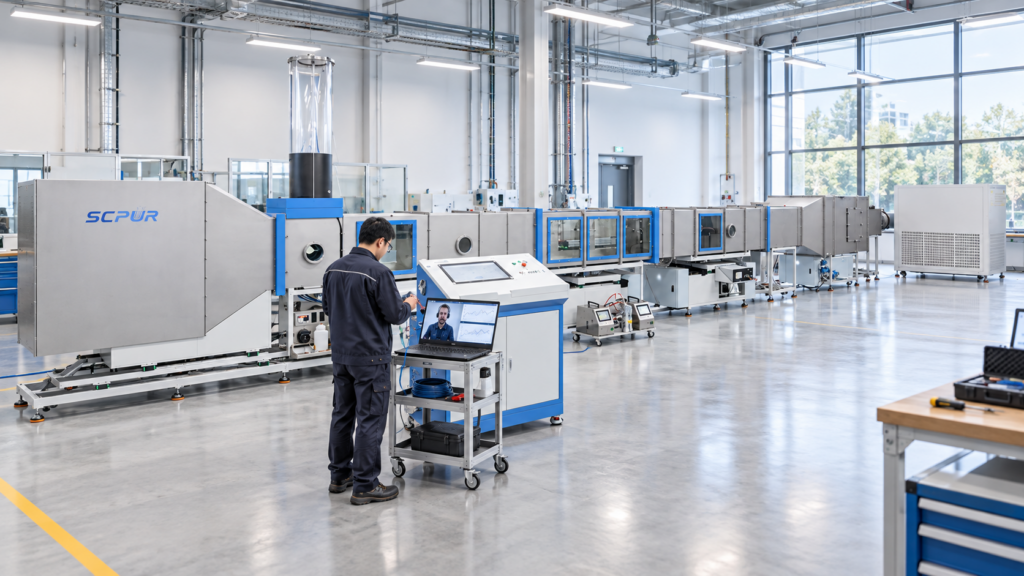
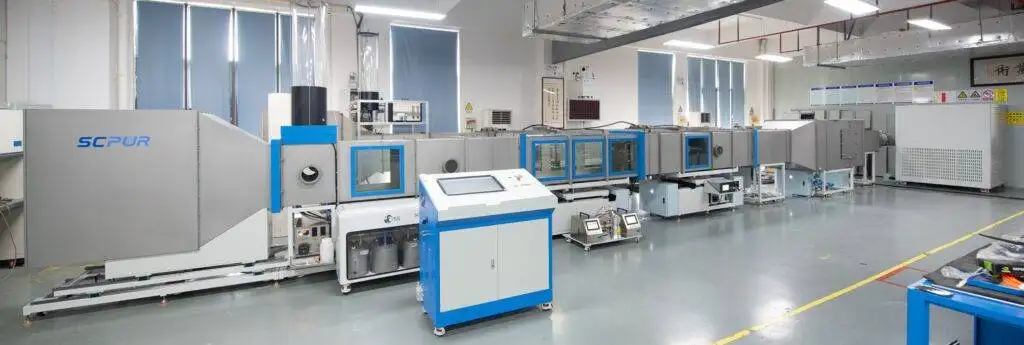
SCPUR SC-5011 Test System
The SCPUR SC-5011 Air Intake Filter Test System is designed for performance testing of dry-type inlet air cleaners used in automotive, heavy-duty and industrial applications.
Depending on the agreed configuration, it supports:
- Airflow–restriction testing
- Initial gravimetric dust efficiency
- Full-life gravimetric dust efficiency
- Incremental dust efficiency
- Dust-capacity testing
- Controlled dust feeding
- Absolute-filter collection
- Electronic weighing data acquisition
- Automatic calculation and report generation
The required system configuration should be selected according to the air cleaner dimensions, rated airflow, expected restriction, test-dust type and required test procedures.
For more information about system configuration and selection, see:
How to Select Engine Air Filter Testing Equipment for ISO 5011
Conclusion
ISO 5011:2025 provides standardized laboratory procedures for comparing inlet air cleaning equipment used with internal combustion engines and compressors.
For dry-type air cleaners, the principal results include:
- Airflow restriction
- Initial dust collection efficiency
- Full-life dust collection efficiency
- Incremental dust collection efficiency
- Dust capacity
The efficiency results are gravimetric and rely on controlled dust feeding, downstream absolute-filter collection and accurate weighing. They should not be confused with particle-counting or fractional-efficiency measurements.
Correct interpretation requires the airflow, test dust, dust concentration, efficiency stage and test endpoint to be clearly identified.
When applied correctly, ISO 5011 testing provides repeatable and meaningful laboratory data for air cleaner development, comparison and technical selection—without claiming to predict exact field service life.
Contact SCPUR to discuss your ISO 5011 test requirements, air cleaner dimensions, rated airflow and required report format.
Official Reference
The applicable standard edition and complete requirements should be confirmed before testing.