


Filtros e meios filtrantes de alta eficiência para remoção de partículas no ar
Compreendendo a ISO 29463 padrão para avaliação de filtros HEPA e ULPA.
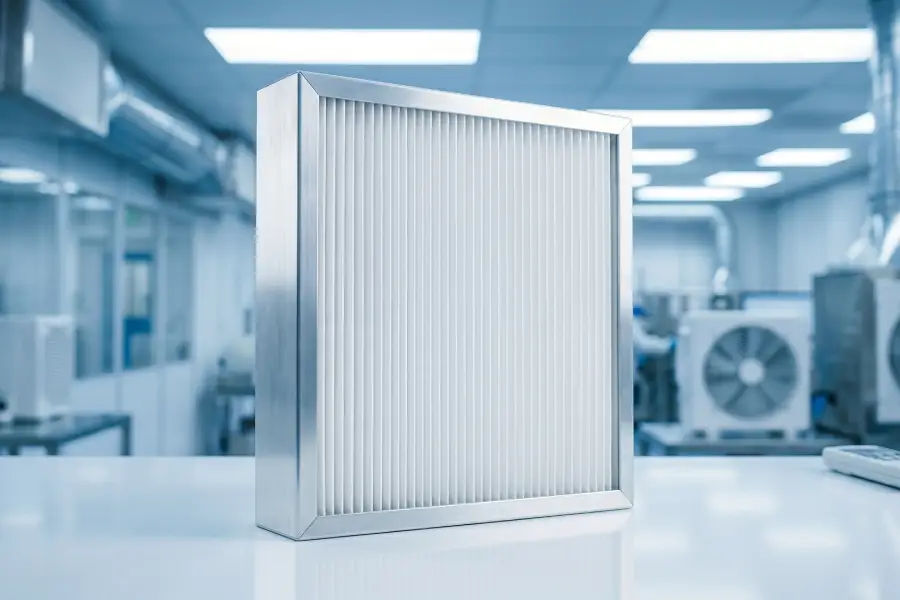
Visão geral da ISO 29463 Padrão
ISO 29463 is an international standard series for classifying and testing high-efficiency filters and filter media used to remove particles from air. It covers filter-media testing, overall filter efficiency, local leak testing, classification and marking.
The standard is used for HEPA and ULPA filters in cleanrooms, produção farmacêutica, semiconductor manufacturing, ventilation systems, controlled environments and other applications requiring high-efficiency particle filtration.

Fabricação de semicondutores

Produção Farmacêutica

Ambientes de sala limpa
Principais métodos de teste em ISO 29463
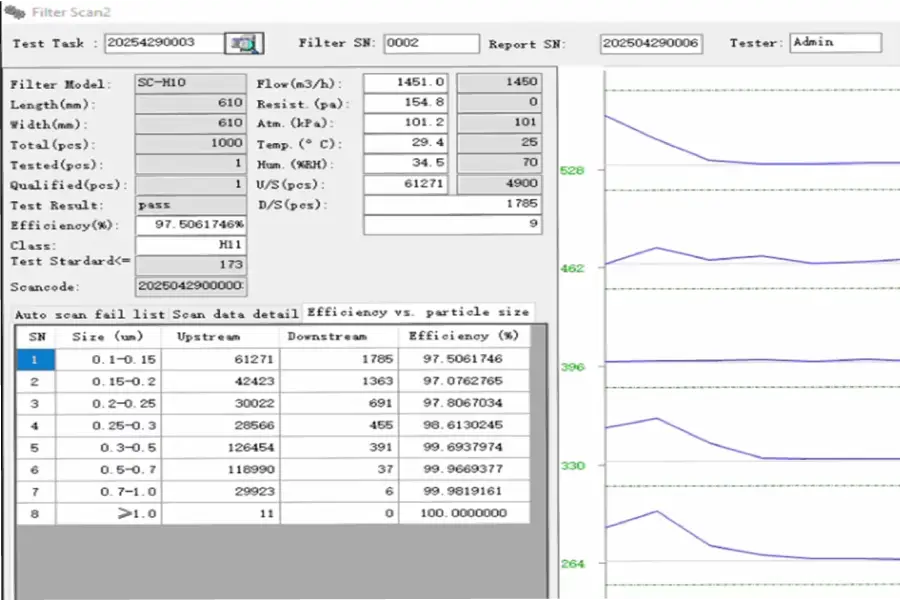
Princípio Chave de Teste: MPPS
MPPS means the most penetrating particle size—the particle size or size range at which the filter media shows its highest penetration, or lowest filtration efficiency, under the specified test conditions.
MPPS is not a fixed value such as 0.3 μm or 0.12 μm for every filter. It depends on the filter media, face velocity, aerosol and test conditions. ISO 29463 therefore uses MPPS-based measurements rather than assigning one universal test particle size to every HEPA or ULPA filter.
Flat-sheet filter media are tested to determine fractional efficiency and identify the MPPS under controlled face-velocity conditions. Media-test results cannot replace testing of the completed filter.
Overall Filter Efficiency
Overall efficiency represents the average penetration of the complete filter at the specified airflow. It evaluates the finished filter as a whole but does not identify the exact location of a small defect.
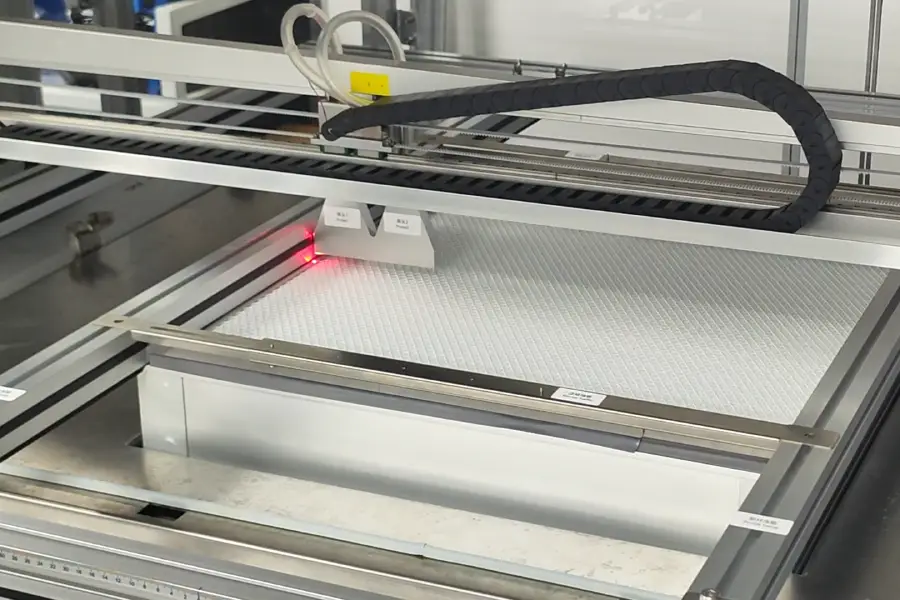
A scan test measures local downstream penetration while the probe moves across the filter face and relevant sealing areas. It is used to locate defects that may not be apparent from the overall efficiency result.
Detecção de vazamento e teste de integridade
ISO 29463 includes methods for evaluating local leakage in applicable filter classes and constructions. The scan method moves a sampling probe across the downstream filter surface to identify areas of excessive local penetration.
The required procedure depends on the filter class, construction and applicable part of the standard. Automatic scanning should therefore not be presented as the only test required for every high-efficiency filter.
Categorias de classificação de filtros HEPA e ULPA
Com base na eficiência medida, os filtros são classificados em diferentes categorias de desempenho. As faixas de classificação típicas incluem:
| Filter Group | General Description |
|---|---|
| EPA | Filtros de partículas de ar eficientes |
| HEPA | Filtros de partículas de ar de alta eficiência |
| ULPA | Filtros de ar de penetração ultrabaixa |
The specific ISO class is determined from the applicable integral and local efficiency or penetration requirements. Class limits should be taken from the specified edition of ISO 29463-1 rather than inferred from the general EPA, HEPA or ULPA group name.
A classificação reflete a capacidade do filtro de remover partículas transportadas pelo ar sob condições de teste padronizadas.
Estrutura e partes da ISO 29463 Padrão
ISO 29463 está organizado em várias partes que cobrem métodos de classificação, procedimentos de teste, e verificação de integridade do filtro. A estrutura típica inclui:
Papel | Escopo |
ISO 29463-1 | Classificação, testes de desempenho e marcação |
ISO 29463-2 | Produção de aerossol, measuring equipment and particle counting methods |
ISO 29463-3 | Teste de mídia filtrante de folha plana |
ISO 29463-4 | Determinação de vazamento e eficiência |
ISO 29463-5 | Teste de eficiência do elemento filtrante |
Estas partes definem coletivamente como os filtros HEPA e ULPA devem ser testados e classificados.
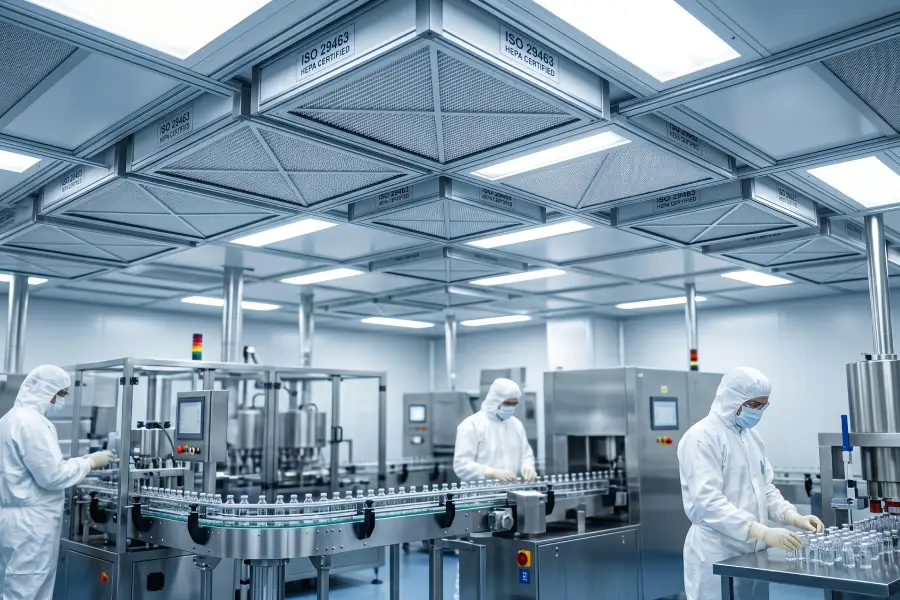
Aplicação em Filtragem de Alta Eficiência
Condições de teste confiáveis e repetíveis são essenciais para garantir que os resultados de eficiência e classificação reflitam o desempenho real dos filtros de alta eficiência. ISO 29463 testes são essenciais para:
- Salas limpas de semicondutores
- Instalações de fabricação farmacêutica
- Laboratórios de Biotecnologia
- Salas de cirurgia hospitalar e enfermarias de isolamento
- Ambientes de fabricação de precisão
ISO 29463 Soluções de teste
ISO 29463 fornece uma estrutura reconhecida mundialmente para avaliar o desempenho do filtro HEPA e ULPA. Ao definir procedimentos padronizados para geração de aerossóis, medição de partículas, e detecção de vazamento, o padrão garante que os resultados de desempenho do filtro sejam consistentes, comparável, e confiável em laboratórios em todo o mundo.
The required equipment depends on the test object and acceptance task:
- Filtrar mídia: fractional efficiency and MPPS measurement
- Complete filters: overall efficiency and airflow resistance
- Factory leak testing: controlled quantitative scanning
- Installed filters: on-site integrity testing of the filter and installation seal
These functions should not be treated as interchangeable simply because they all use an aerosol challenge and downstream measurement.
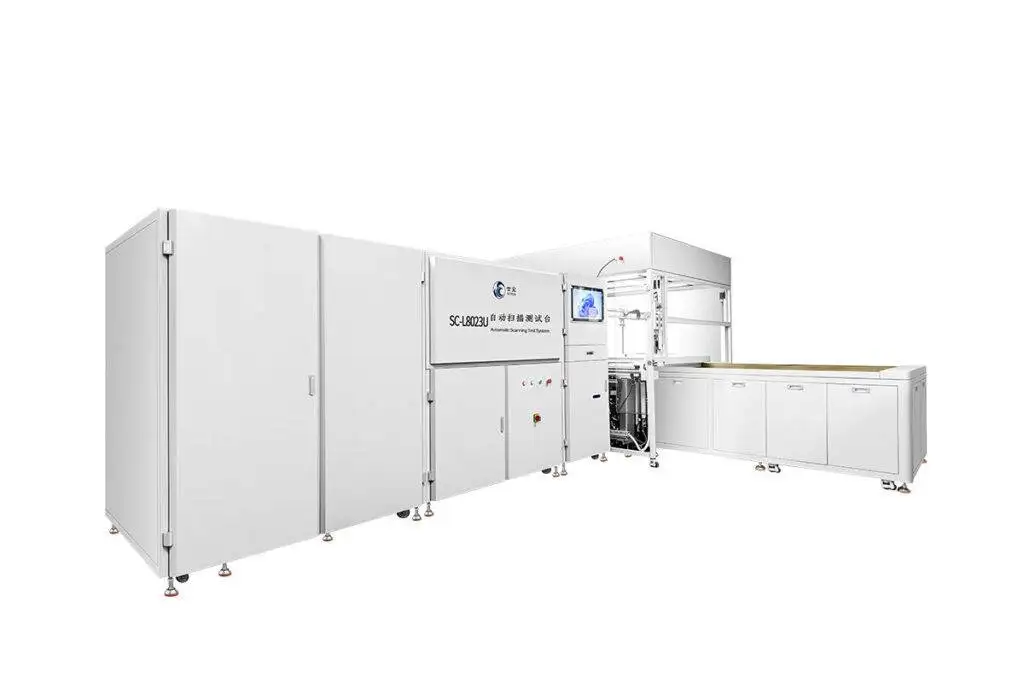
Relação com outros padrões
ISO 29463 está intimamente relacionado a vários outros padrões de filtração.
-
PadrãoEN1822
-
AplicativoClassificação Europeia HEPA/ULPA
-
PadrãoISO16890
-
AplicativoFiltros de ar para ventilação geral
-
PadrãoASHRAE 52.2
-
AplicativoTestes de filtragem HVAC na América do Norte
Enquanto ISO 16890 e ASHRAE 52.2 foco em filtros de ventilação geral, ISO 29463 aborda especificamente a filtragem de salas limpas de alta eficiência.
Discuta seus requisitos de teste de filtragem
Diga-nos o seu tipo de filtro, padrão de teste, e cenário de aplicação.
Nossos engenheiros ajudarão você a identificar a solução de teste mais adequada — desde sistemas padrão até plataformas totalmente personalizadas.