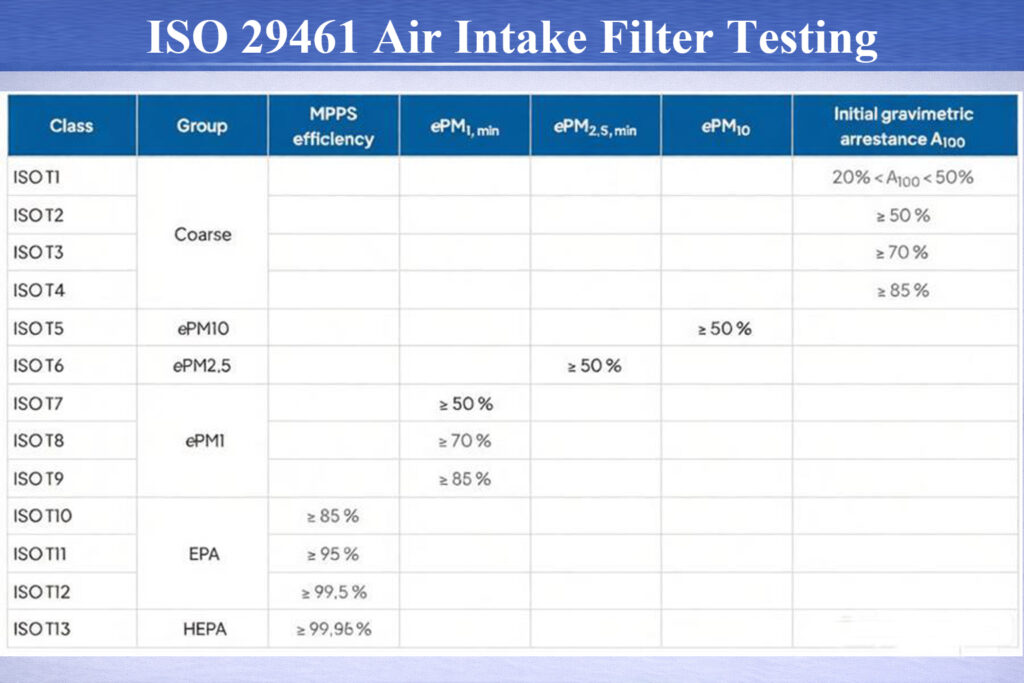
In modern air filtration applications, users are increasingly concerned with how well filters remove particles in the PM2.5 and PM10 size ranges. ISO 16890 is now the leading international standard for evaluating air filter performance for general ventilation.
This article provides a clear explanation of how ISO 16890 defines and measures ePM1, ePM2.5, ePM10, and Coarse filtration efficiencies, as well as key topics such as aerosol types, particle size classification, data processing, and equipment design requirements.
Why Move from EN779 to ISO 16890?
ISO 16890 was developed to replace EN779 in order to establish a more realistic and globally harmonized testing method for air filters. It reflects real-world performance better by:
Measuring efficiency across a range of particle sizes (not just 0.4 μm)
Providing classification based on PM1, PM2.5, and PM10 mass efficiency
Offering results that correspond to actual environmental air quality metrics
Why Introduce IPA Neutralization?
Many modern filters use electrostatic charge to enhance initial efficiency. However, these effects can degrade quickly in real use due to humidity, aging, or dust loading. ISO 16890 introduces IPA vapor treatment to eliminate this charge and determine the minimum efficiency—the worst-case performance based purely on mechanical filtration.
By averaging the initial and minimum efficiency, the classification becomes:
More realistic to long-term performance
More consistent and comparable
Fairer across different media types (electrostatic vs. mechanical)
Aerosol Types: DEHS and KCl
To test across the full range of relevant particle sizes, ISO 16890 recommends using:
| Aerosol Type | Particle Size Range (μm) | Purpose |
| DEHS | 0.3 – 1.0 | Fine particles (ePM1) |
| KCl | 1.0 – 10.0 | Medium to large particles (ePM2.5, ePM10) |
This dual-source approach ensures coverage of the full 0.3–10 μm range.
Particle Size Distribution and Instrument Requirements
The ISO 16890 test defines 13 particle size bins from 0.3 to 10 μm. Filters are evaluated on how efficiently they remove particles in these bins, with weighted mass efficiencies calculated for each level (ePM1, ePM2.5, ePM10).
| Bin | Size Range (μm) |
| 1 | 0.30 – 0.40 |
| 2 | 0.40 – 0.55 |
| 3 | 0.55 – 0.70 |
| 4 | 0.70 – 1.00 |
| 5 | 1.00 – 1.30 |
| 6 | 1.30 – 1.60 |
| 7 | 1.60 – 2.20 |
| 8 | 2.20 – 3.00 |
| 9 | 3.00 – 4.00 |
| 10 | 4.00 – 5.50 |
| 11 | 5.50 – 7.00 |
| 12 | 7.00 – 8.50 |
| 13 | 8.50 – 10.00 |
Efficiency range breakdown:
ePM1: weighted over bins 1–4 (0.3–1.0 μm)
ePM2.5: bins 1–7 (0.3–2.5 μm)
ePM10: all bins 1–13 (0.3–10.0 μm) Instruments must:
Detect particles across 0.3–10 μm
Resolve at least 12–13 size channels as defined
Count ≥500 particles per bin to ensure statistical accuracy
Recommended tools include optical particle counters (OPC), aerodynamic particle sizers (APS), and advanced multi-channel systems.
ePMx Calculation Method
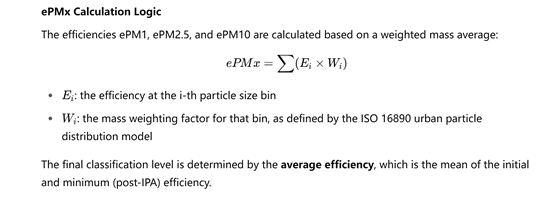
The efficiencies ePM1, ePM2.5, and ePM10 are calculated based on a weighted mass average:
Ei: the efficiency at the i-th particle size bin.
Wi: the mass weighting factor for that bin, as defined by the lSO 16890 urban particledistribution model.

The final classification level is determined by the average efficiency, which is the mean of the initialand minimum (post-lPA) efficiency.
IPA Treatment: Controlling for Electrostatic Effects
Filters that rely on electrostatic charge can lose efficiency over time. To ensure consistent and fair classification, ISO 16890 requires the filter be exposed to IPA vapor before testing to eliminate this charge. This gives the minimum efficiency, reflecting worst-case mechanical-only performance.
The average of initial and minimum efficiency is then used to assign ePM1, ePM2.5, or ePM10 classification levels.
ISO Coarse Filters: When ePM10 < 50%
If a filter’s ePM10 efficiency is less than 50%, it cannot be classified as ePM1–10. Instead, it is tested for
gravimetric (weight-based) efficiency:
- Load with ISO A2 dust
- Measure mass before and after loading
- Determine:
![]() Initial gravimetric efficiency
Initial gravimetric efficiency
Dust holding capacity before reaching final resistance
What Does the Final Report Include?
Initial, minimum, and average efficiencies
ePM classification (ePM1, ePM2.5, ePM10)
Particle size efficiency distribution chart
Dust loading curve and pressure drop evolution
Gravimetric results for Coarse classification
Key Features Required for Testing Equipment
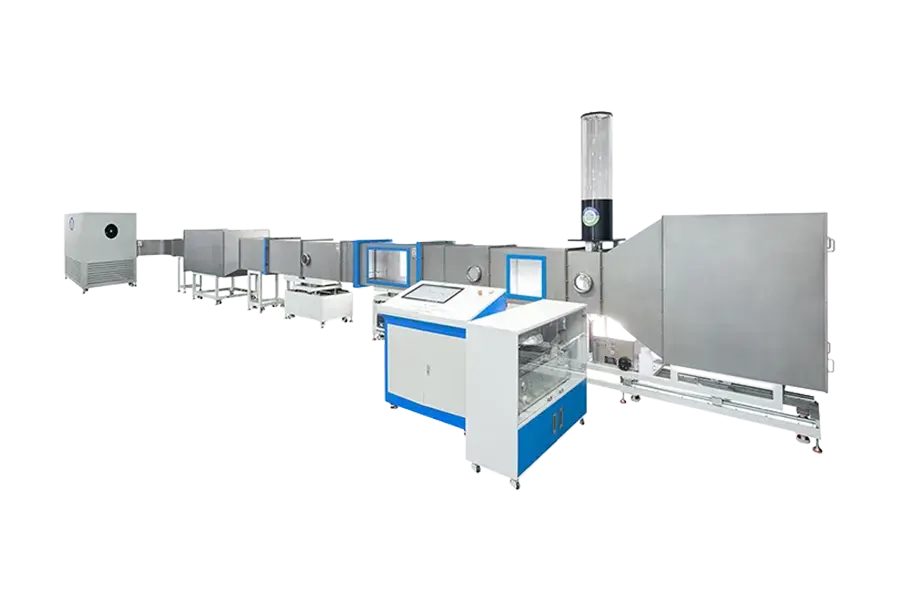
To comply with ISO 16890, a test system should include the following core modules:
Duct and fan system: Provides stable and adjustable test airflow (typically 500–4500 m³/h) while maintaining uniform velocity across the filter face.
Oil and salt aerosol generators: Capable of generating stable particle output for both DEHS and KCl. For large particles (e.g., 10 μm KCl), the system must produce ≥500 particles per minute per size channel.
Dust loading system: Supports continuous injection of ISO A2 test dust, with an integrated weighing system that automatically captures and records dust mass before and after loading.
Particle counter: Must support sampling across the 0.3–10 μm range with 12 or more defined size bins to ensure resolution meets ISO classification standards.
Data calculation and control system: Coordinates fan and generator operations, links to particle counters and dilution systems, and automatically performs upstream/downstream switching, efficiency calculation, average efficiency determination, and report generation.
Conclusion
ISO 16890 brings air filter testing closer to real-world performance expectations. By understanding its classification logic, test procedures, and instrumentation demands, manufacturers can design better filters—and users can better trust the performance labels they rely on.