

Air intake filtration plays an important role in protecting gas turbines, compressors and other rotary machinery from airborne contamination.
Particles entering the machine can contribute to compressor fouling, erosion, reduced operating efficiency and increased maintenance requirements. At the same time, the filtration system must supply the required airflow without creating excessive pressure loss.
ISO 29461-1:2021 provides a standardized laboratory framework for evaluating the static performance of individual air intake filter elements used in these applications.
What Does ISO 29461-1 Cover?
ISO 29461-1 applies to particulate air filters used in the air intake systems of rotary machinery, including:
- Stationary gas turbines
- Industrial compressors
- Stationary internal combustion engines
- Power-generation and other industrial air intake systems
The standard primarily covers individual static, or barrier-type, filter elements. It does not normally evaluate the performance of an entire filtration system after installation in the field, unless the complete assembly meets the qualification requirements of the test arrangement.
ISO 29461-1 applies and extends established filter test methods from two other international standard series:
- Lower-efficiency filters are tested according to the ISO 16890 series.
- EPA and HEPA filters with an efficiency of 85% or higher at the most penetrating particle size, or MPPS, are tested according to the ISO 29463 series.
ISO 29461-1 therefore should not be considered an entirely separate filtration classification method. It connects ISO 16890 and ISO 29463 test procedures with the specific requirements of rotary machinery air intake applications.
Applicable Airflow Range
ISO 29461-1 covers filter elements operating at airflow rates from:
0.24 to 2.36 m³/s, equivalent to 850 to 8,500 m³/h
This extended airflow range is important because industrial air intake filters may operate at higher airflow rates than conventional general ventilation filters.
Testing at these airflow rates requires careful control of:
- Airflow stability
- Airflow measurement accuracy
- Pressure drop measurement
- Aerosol concentration and uniformity
- Upstream and downstream sampling
- Filter sealing
- Duct and test rig structural stability
The selected test airflow should correspond to the intended operating condition and the requirements of the applicable test procedure.
Main Performance Parameters
The exact test programme depends on the filter efficiency, application and required report. Typical evaluations may include the following.
1. Airflow Resistance
The pressure drop across the filter is measured at specified airflow rates.
This measurement shows how much resistance the filter introduces into the air intake path. Pressure drop is particularly important in rotary machinery applications because it can affect the amount of air available to the machine and the energy required to move air through the filtration system.
Testing may include:
- Initial pressure drop at the rated airflow
- Resistance at multiple airflow points
- Resistance development during dust loading
- Final resistance at the defined test endpoint
A complete pressure-drop curve provides more useful information than a single measurement point.
2. Fractional Efficiency and ePM Performance
For lower-efficiency filters, particle efficiency is evaluated using procedures from the ISO 16890 series.
Fractional efficiency is determined across the specified particle size range by comparing upstream and downstream particle concentrations. The measurement results are then used to calculate particulate matter efficiencies such as:
- ePM1
- ePM2.5
- ePM10
These results describe the performance of the filter for different particulate matter fractions.
Where conditioning according to ISO 16890-4 is required, the purpose is to determine the minimum fractional efficiency and evaluate the influence of electrostatic filtration mechanisms. This conditioning process should not be confused with a high-humidity or environmental endurance test.
3. MPPS Efficiency for EPA and HEPA Filters
Higher-efficiency filter elements cannot be evaluated only by their ePM performance.
For EPA and HEPA filters with an efficiency of 85% or higher at MPPS, ISO 29461-1 refers to the ISO 29463 series. The filter is evaluated at or around its most penetrating particle size, where penetration is highest and filtration efficiency is lowest.
Depending on the applicable test method and reporting requirements, the evaluation may include:
- Determination of MPPS
- Overall efficiency at MPPS
- Overall penetration
- Filter classification according to ISO 29463
- Airflow resistance at the specified test condition
The particle measurement instruments and aerosol generation system must be selected according to the expected efficiency and particle size range.
4. Dust Loading and Resistance Development
Dust loading can be used to evaluate how the filter behaves as a defined quantity of standardized test dust is introduced.
Depending on the selected procedure, the test may evaluate:
- Gravimetric efficiency
- Mass of dust captured
- Dust holding behaviour
- Increase in airflow resistance
- Filter performance at defined loading stages
- Performance at the specified final pressure drop
Dust loading provides standardized comparative data. However, it does not reproduce every condition encountered in an actual gas turbine or compressor installation.
The composition and concentration of atmospheric particles, humidity, water droplets, salt, operating schedule, installation quality and maintenance strategy can all influence actual service performance.
For this reason, ISO 29461-1 test results alone cannot be used to calculate the exact efficiency or service lifetime of a filter in the field.
Typical Testing Process
A test programme should be defined according to the filter type and the required standard results. A typical process may include:
- Recording the filter identification, dimensions and rated airflow
- Inspecting the filter and installing it in the test section
- Verifying the seal between the filter and the mounting frame
- Measuring initial pressure drop at the specified airflow points
- Performing fractional-efficiency testing according to ISO 16890
- Performing MPPS efficiency testing according to ISO 29463 when applicable
- Conducting conditioning or dust-loading procedures when required
- Recording resistance and other performance changes at the specified stages
- Completing the required calculations and classifications
- Generating a traceable test report
Not every filter requires every test listed above. The applicable sequence depends on the filter efficiency, intended application and agreed test scope.
ISO 29461-1 and ISO 16890: How Are They Related?
ISO 16890 is intended for air filters used in general ventilation. Its primary result is a PM-based classification, such as ISO ePM1, ISO ePM2.5, ISO ePM10 or ISO Coarse.
ISO 29461-1 is intended specifically for air intake filters protecting rotary machinery. For lower-efficiency filters, it uses and extends ISO 16890 procedures to address the airflow range and application requirements of industrial air intake filtration.
The main differences can be summarized as follows:
| Aspect | ISO 16890 | ISO 29461-1 |
| Main application | General ventilation | Rotary machinery air intake |
| Primary purpose | PM-based filter classification | Static performance evaluation for machinery protection |
| Lower-efficiency filters | Tested directly according to ISO 16890 | ISO 16890 procedures are applied and extended |
| EPA and HEPA filters | Outside the principal ePM classification scope | ISO 29463 procedures are applied |
| Airflow range | 900 to 5,400 m³/h for a nominal 610 × 610 mm test rig | 850 to 8,500 m³/h |
| Main test object | Individual general ventilation filter elements | Individual static air intake filter elements |
| Field lifetime prediction | Not directly provided | Not directly provided |
A filter intended for a gas turbine air intake system may therefore require results according to both ISO 16890 and ISO 29461-1.
For a more detailed explanation, see:
ISO 29461-1 vs. ISO 16890: What Is the Difference?
Testing Multistage Filtration Systems
Rotary machinery air intake systems commonly use multiple filtration stages, which may include:
- Coarse prefilters
- Fine filters
- EPA filters
- HEPA filters
ISO 29461-1 primarily evaluates individual filter elements rather than the complete system as installed at the operating site.
For multistage systems using fine filters, cumulative efficiency can be calculated using methods described in ISO 16890-1. However, calculated cumulative efficiency should not be treated as a substitute for evaluating installation leakage, sealing quality or the performance of the complete field-installed system.
Challenges in Air Intake Filter Testing
Accurate testing at high airflow requires more than a large fan and a particle counter.
The complete test system must maintain controlled and repeatable conditions throughout the test. Important technical considerations include:
- Stable airflow over a wide operating range
- Accurate flow measurement
- Adequate upstream aerosol mixing
- Representative upstream and downstream sampling
- Suitable particle measurement instruments
- Controlled switching between sampling positions
- Stable and repeatable dust feeding
- Accurate differential pressure measurement
- Reliable sealing around different filter sizes
- Traceable data acquisition and calculation
- Correct test sequencing and report generation
Measurement-system verification is also essential. Background concentration, instrument zero, upstream and downstream correlation, sampling delay and dilution ratio can all influence the final efficiency result.
Choosing an ISO 29461-1 Test System
The required system configuration depends on more than the maximum airflow.
Before selecting or designing a test system, the following information should be defined:
- Filter dimensions and installation method
- Rated and maximum test airflow
- Expected filter efficiency
- Required particle size range
- ISO 16890 testing requirements
- ISO 29463 or EN 1822 testing requirements
- Dust-loading requirements
- Final pressure-drop condition
- Required test reports
- Future expansion requirements
A system designed only for conventional HVAC filter testing may not provide the airflow capacity, pressure capability or particle measurement range required for a complete rotary machinery air intake filter programme.
SCPUR Air Intake Filter Testing Solutions
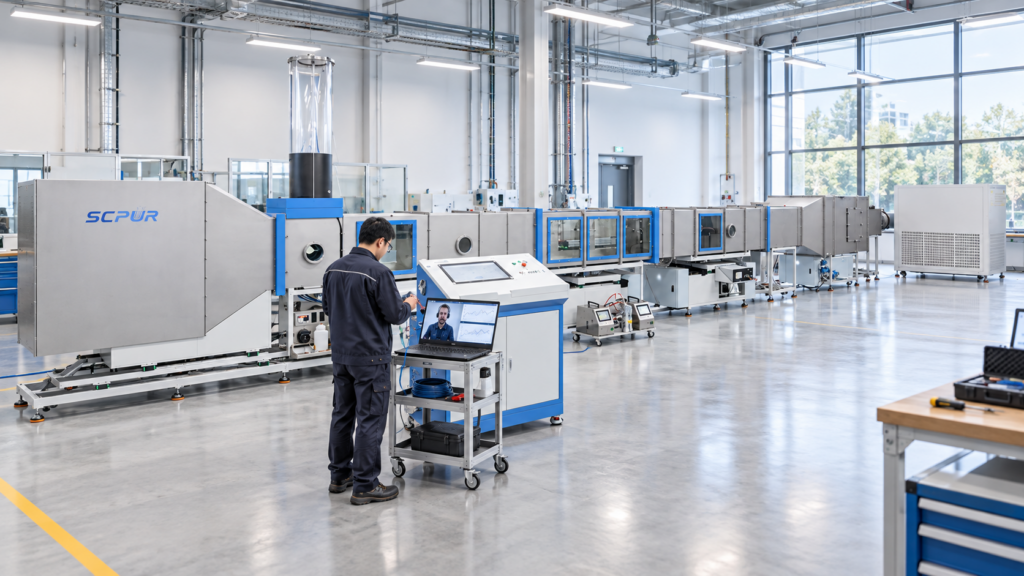
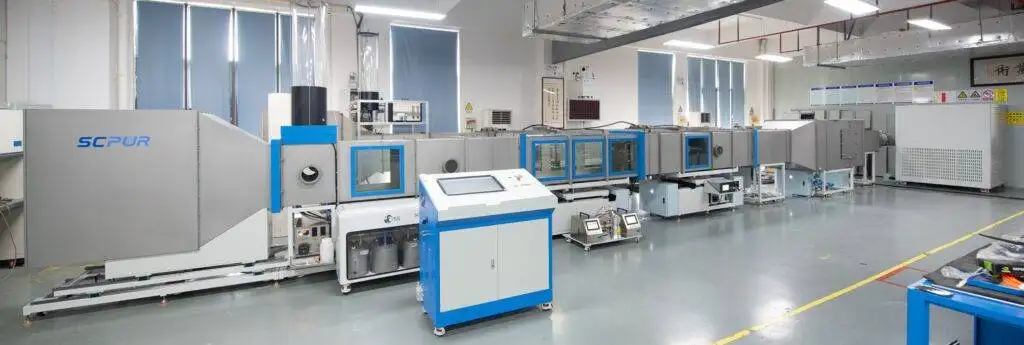
SCPUR develops automated filter test systems for gas turbine and industrial air intake filter applications.
Our systems can be configured to integrate relevant procedures from:
- ISO 29461-1
- ISO 16890
- ISO 29463
- EN 1822
- EN 779, where historical comparison is required
Depending on the application, the system can incorporate airflow and pressure control, fractional-efficiency measurement, MPPS testing, dust loading, gravimetric measurement, automatic test sequences and report generation.
The appropriate configuration is selected according to the filter size, efficiency range, airflow requirement and testing objectives.
Conclusion
ISO 29461-1:2021 provides a standardized method for evaluating the static performance of air intake filter elements used to protect gas turbines, compressors and other rotary machinery.
Its most important feature is its connection with other established filtration standards:
- ISO 16890 is applied to lower-efficiency filters.
- ISO 29463 is applied to EPA and HEPA filters.
- ISO 29461-1 extends these procedures for rotary machinery air intake applications and airflow rates up to 8,500 m³/h.
The standard provides controlled and comparable laboratory data for efficiency, pressure drop and other relevant filter characteristics. These results support filter development, product comparison and technical selection, but they should not be interpreted as a direct prediction of field lifetime.
Looking for a test solution for gas turbine or compressor air intake filters?
Contact SCPUR to discuss your filter dimensions, airflow range, efficiency level and required test standards.
Official References
- ISO 29461-1:2021 — Air intake filter systems for rotary machinery
- ISO 16890-1 — Classification based on particulate matter efficiency
- ISO 16890-2 — Fractional efficiency and airflow resistance
- ISO 16890-3 — Gravimetric efficiency and dust loading
- ISO 16890-4 — Conditioning and minimum fractional efficiency
Standards are periodically reviewed and revised. The applicable edition and complete requirements should be confirmed before testing.
Recommended Test System:👉SC-29461-1 Gas Turbine Air Intake Filter Test System