

There is no single air filter test standard that answers every performance question. A general ventilation filter, a HEPA filter, an engine air cleaner, and a gas-turbine intake filter may all remove particles from air, but they are evaluated for different applications and with different evidence.
The most useful starting question is therefore not “Which standard is the most advanced?” It is:
What product is being tested, and what decision must the result support?
A manufacturer may need to classify a filter, compare two designs, release a production batch, locate a leak, qualify a supplier, or demonstrate dust-holding performance to a customer. Each purpose leads to a different combination of standard, طريقة الاختبار, challenge aerosol or dust, تدفق الهواء, instrumentation, and report.
This guide provides a practical route to the main standards used for complete air filter and air-cleaner testing.
دليل الاختيار السريع
دليل الاختيار السريع
| Standard family | Typical test object | Main result | Core measurement approach |
|---|---|---|---|
| ايزو 16890 | General ventilation filter elements | ISO Coarse, ePM10, ePM2.5 or ePM1 group | Fractional particle efficiency, conditioned efficiency, airflow resistance and dust loading |
| أشراي 52.2 | General ventilation air-cleaning devices | MERV وبيانات كفاءة حجم الجسيمات | Particle counting from 0.3 ل 10 μm, resistance and staged dust loading |
| في 1822 / ايزو 29463 | EPA, HEPA and ULPA filter media and elements | High-efficiency class, integral efficiency and local penetration where applicable | MPPS determination, upstream/downstream aerosol measurement and filter-element leak testing |
| ايزو 5011 | Air cleaners for internal combustion engines and compressors | تقييد, gravimetric efficiency, dust capacity and related performance data | غبار اختبار موحد, وزن, airflow and differential-pressure measurement |
| ايزو 29461 مسلسل | Air intake filters for stationary rotary machinery | ISO T classification and application-specific performance evidence | ايزو 16890- or ISO 29463-based particle testing at the applicable airflow, plus separate endurance methods in other parts |
| ايزو 11155 مسلسل | Passenger-compartment air filters | Particle or gas filtration performance, depending on the part | Cabin-filter-specific aerosol, gas, resistance and holding-capacity methods |
This table is a navigation aid, not a conversion chart. A MERV value cannot be converted exactly into an ePM group, and neither can be converted into a HEPA class or ISO T class without performing the applicable test.
Start with the Test Object, Not the Filter Shape
Start with the Test Object, Not the Filter Shape
Two filters can look similar and still require different standards. A pleated panel may be used in an air-handling unit, a vehicle intake, a gas-turbine inlet, or a cleanroom terminal housing. Its geometry alone does not define the correct test.
Before selecting a standard, identify:
- the machine or ventilation system the filter protects;
- whether the test object is media, an individual element, a complete air cleaner, or an installed filtration system;
- the rated airflow and allowable pressure drop;
- the particle-size range or dust challenge of interest;
- whether the required output is a class, a curve, a pass/fail result, or lifetime-related comparative data; و
- the edition and acceptance criteria stated in the customer specification or purchase contract.
This step prevents a common mistake: selecting a familiar standard first and then trying to force the product into its method.
ايزو 16890: مرشحات التهوية العامة
ايزو 16890: مرشحات التهوية العامة
الأيزو 16890 series is intended for particulate air filter elements used in general ventilation. It classifies filters according to their calculated efficiency for PM1, PM2.5, and PM10 fractions, or as ISO Coarse when the relevant ePM threshold is not reached.
The PM results are calculated from measured fractional-efficiency data using standardized reference particle-size distributions. This is more informative than assigning a filter only a broad coarse or fine label, but it should not be described as a direct simulation of every real atmosphere. Actual service performance is also affected by local aerosol composition, رطوبة, loading rate, installation, صيانة, and operating schedule.
ايزو كامل 16890 platform may need to support:
- airflow and pressure-drop measurement;
- upstream and downstream fractional-efficiency measurement;
- the required aerosol-generation and particle-counting ranges;
- conditioning to evaluate discharged efficiency;
- gravimetric dust loading and resistance development; و
- automatic calculation of the final ISO group and report.
اختر ايزو 16890 when: the product is a general ventilation filter and the market or customer requires an ISO ePM or ISO Coarse classification.
أشراي 52.2: General Ventilation Devices Rated by MERV
أشراي 52.2: General Ventilation Devices Rated by MERV
ANSI/ASHRAE Standard 52.2 is also intended for general ventilation air-cleaning devices, but it reports performance using particle-size removal efficiency and the MERV system. The current 2025 edition measures particle removal over the 0.3 ل 10 μm range while the device is loaded at defined intervals with standardized loading dust.
ايزو 16890 و أشراي 52.2 overlap in product category, but their aerosols, calculations, loading procedures, التصنيفات, and reporting rules are not identical. An approximate cross-reference sometimes used for market communication is not a substitute for testing under the specified standard.
اختر أشراي 52.2 when: the customer, market, building specification, or product label requires a MERV rating or the ASHRAE particle-size efficiency method.
في 1822 و ايزو 29463: EPA, مرشحات HEPA وULPA
في 1822 و ايزو 29463: EPA, مرشحات HEPA وULPA
في 1822 و ايزو 29463 apply to high-efficiency filters and filter media. Their central concept is performance at the most penetrating particle size, أو MPPS, where the filter has its highest penetration and lowest efficiency.
Depending on the filter class and applicable method, the required evidence can include:
- determination of the MPPS of the filter medium;
- integral efficiency or penetration at MPPS;
- local penetration or leak scanning of the complete filter element;
- airflow resistance at the specified test condition; و
- traceable classification and test records.
These standards are closely related, but their class designations and some method rules should not be treated as interchangeable. The required measurement range also depends on the expected efficiency. أ 0.3 μm optical particle counter used for internal production screening is not automatically a complete MPPS classification system.
اختر إن 1822 أو ISO 29463 when: the product is an EPA, HEPA, or ULPA filter and the customer requires formal high-efficiency classification, كفاءة متكاملة, or filter-element leak evidence.
Installed-system integrity testing after a filter is mounted in a cleanroom or housing is a separate activity. It should not be confused with factory classification and scanning of the filter element.
ايزو 5011: Engine and Compressor Air Cleaners
ايزو 5011: Engine and Compressor Air Cleaners
ايزو 5011 establishes laboratory procedures for comparing air cleaners used on internal combustion engines and compressors in automotive and industrial applications. It is not limited to passenger vehicles.
Its central outputs include airflow restriction or differential pressure, gravimetric dust-collection efficiency, dust capacity, and related performance characteristics. ال 2025 edition also retains provisions relevant to oil-bath air cleaners.
The basic measurement chain is gravimetric. Standardized test dust is fed into the airflow, and the mass retained by the test air cleaner and downstream collection system is used with airflow and pressure data to calculate performance. Particle counters are not a replacement for the required mass measurements.
اختر ايزو 5011 when: the test object is an engine or compressor air cleaner and the required evidence concerns restriction, gravimetric efficiency, القدرة على الاحتفاظ بالغبار, or full-life laboratory comparison.
ايزو 29461: A Series for Rotary-Machinery Air Intake Filtration
ايزو 29461: A Series for Rotary-Machinery Air Intake Filtration
ايزو 29461 should not be summarized as only “PM classification” or “real-environment simulation.” It is a multi-part series for air intake filtration used to protect stationary rotary machinery such as gas turbines and industrial compressors.
| جزء | Main purpose |
|---|---|
| ايزو 29461-1 | Static performance of individual filter elements. It applies and extends ISO 16890 methods for lower-efficiency filters and ISO 29463 methods for EPA/HEPA filters over an airflow range of 850 ل 8,500 m³/h. |
| ايزو 29461-2 | Laboratory evaluation of filter-element water endurance in fog and mist environments. |
| ايزو 29461-3 | Mechanical-integrity testing under defined abnormal operating conditions. |
| ايزو 29461-4 | Testing of individual elements and complete static filtration systems for coastal and offshore environments using ultrafine salt and variable humidity. |
جزء 1 normally concerns individual static filter elements, not direct measurement of a complete filtration system after installation in service. Its results also cannot, by themselves, predict exact field efficiency or service lifetime.
اختر ايزو 29461-1 when: the filter protects stationary rotary machinery and the customer needs the applicable ISO T classification and performance data at the relevant industrial airflow.
Add another part of the ISO 29461 series when: water endurance, mechanical integrity, or coastal/offshore salt-and-humidity performance is part of the actual project requirement.
Can the Same Filter Require More Than One Standard?
Can the Same Filter Require More Than One Standard?
نعم. The intended market and customer evidence can create overlapping requirements.
Examples include:
- a gas-turbine intake element evaluated according to ISO 29461-1 while its lower-efficiency particle data are produced using methods derived from ISO 16890;
- an EPA or HEPA intake element evaluated within ISO 29461-1 using ISO 29463-based methods;
- a general ventilation filter sold into both ISO and North American markets, requiring ISO 16890 و أشراي 52.2 results; أو
- a manufacturer using a simplified internal production check between full classification tests.
The reports should keep the methods and resulting classifications separate. Combining results from different standards into one unsupported “equivalent” class creates risk for both the manufacturer and its customer.
Test Equipment Must Match the Complete Method
Test Equipment Must Match the Complete Method
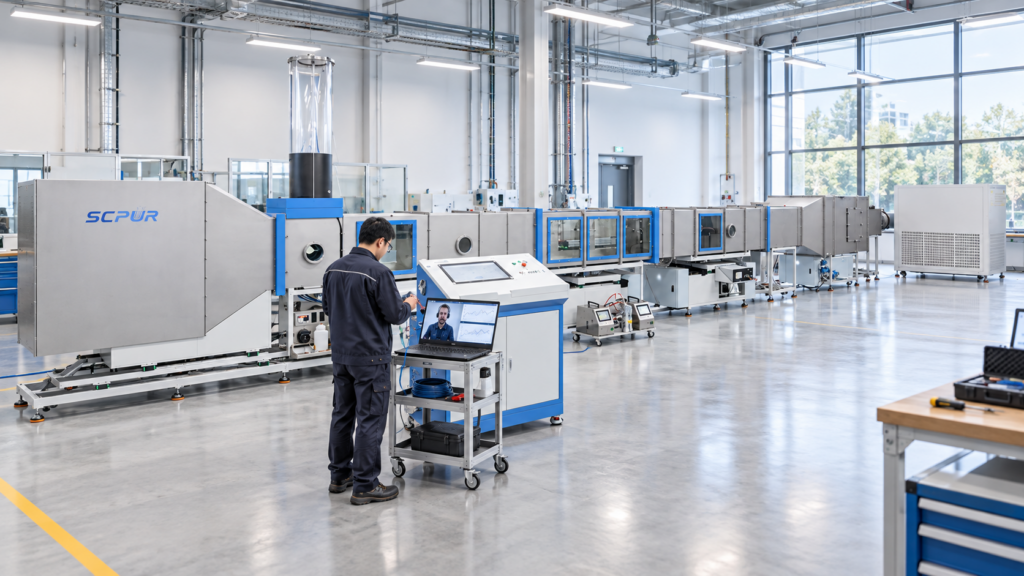
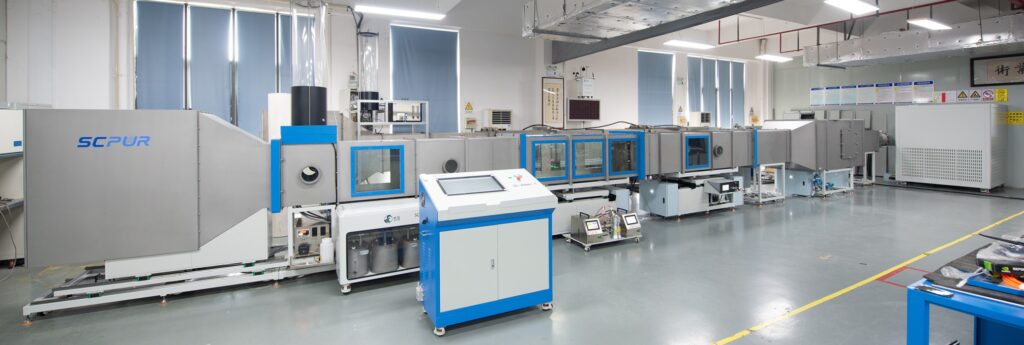
Listing several standards in a product brochure does not prove that a test system can perform each complete method. Before configuring equipment, check whether the platform includes the required:
- airflow range and test-section dimensions;
- mounting, ختم, and adapter arrangement;
- aerosol generators or standardized dust feeder;
- optical particle counter, submicron instrument, or gravimetric collection system;
- upstream and downstream sampling arrangement;
- تكييف, رطوبة, water, ملح, or mechanical-stress subsystem where applicable;
- differential-pressure and airflow measurement ranges;
- balances and mass-data acquisition for gravimetric methods; و
- software sequence, calculations, acceptance logic, and report fields for the specified edition.
Some standards can share airflow-control, duct, and data-acquisition infrastructure. Other methods require fundamentally different challenge and measurement chains. The equipment specification should therefore be built from the required test outputs, not from a list of standard names.
A Five-Question Selection Checklist
A Five-Question Selection Checklist
Before requesting a quotation or approving a test plan, answer these five questions:
- What is the test object? وسائط, filter element, complete air cleaner, multistage assembly, or installed system?
- What application will it serve? التهوية العامة, cleanroom production, engine intake, passenger compartment, gas turbine, compressor, or offshore intake?
- What result must appear on the report? ePM group, MERV, MPPS class, ISO T class, local penetration, restriction, gravimetric efficiency, or dust capacity?
- At what conditions? حجم الفلتر, تدفق الهواء المقدر, resistance range, aerosol or dust, conditioning state, and final test endpoint?
- Who defines acceptance? The current standard, a customer specification, a product-development plan, or an internal production-control method?
Once these inputs are clear, the correct standard and test-system configuration become much easier to define.
SCPUR develops test systems around the evidence filter manufacturers need to produce: تصنيف, design comparison, production release, leak localization, dust-loading evaluation, or customer-specific validation.
Start with your filter, تدفق الهواء المقدر, and required report: Explore SCPUR air filter testing systems
- HVAC and General Ventilation Filter Testing Systems
- HEPA and ULPA Filter Testing Systems
- Engine and Turbine Intake Filter Testing Systems
- ايزو 29461-1 مقابل ايزو 5011: Which Standard Should You Choose?
- في 1822 مقابل ايزو 29463: فصول, الاختبارات والاختلافات الرئيسية
- اختبار تسرب مرشح HEPA: Factory Scan vs Installed-System Test
- ايزو 16890-1:2016 – General ventilation filter classification
- ANSI/ASHRAE Standard 52.2-2025 – Purpose and scope
- بكالوريوس إن 1822-1:2019 – تصنيف, اختبار الأداء ووضع العلامات
- ايزو 29463-1:2024 – تصنيف, أداء, الاختبار ووضع العلامات
- ايزو 5011:2025 – Inlet air-cleaning equipment performance testing
- ايزو 29461-1:2021 – Static filter elements for rotary machinery
- ايزو 29461-2:2022 – Fog and mist endurance
- ايزو 29461-3:2024 – Mechanical integrity
- ايزو 29461-4:2025 – Coastal and offshore environments
- ISO/TS 11155-1:2001 – Passenger-compartment particulate filtration