

ايزو 29461-1 و ايزو 5011 are both used in air-intake filtration, but they do not ask the same performance question.
- ايزو 29461-1 evaluates the static performance of particulate filter elements used in air intake systems for stationary rotary machinery. Depending on filter efficiency, it applies and extends ISO 16890 أو ISO 29463 methods and produces the applicable ISO T classification and supporting particle-efficiency data.
- ايزو 5011 provides laboratory procedures for comparing air cleaners used on internal combustion engines and compressors. Its core results are based on restriction, gravimetric dust-collection efficiency, dust capacity, and related performance characteristics.
The difference is therefore not simply “industrial filters versus automotive filters.” Both standards can appear in industrial compressor or stationary-engine projects. Selection depends on the test object, customer specification, challenge material, required result, and measurement method.
Current Editions and Scope
Current Editions and Scope
This comparison uses the current editions available at the time of publication:
- ايزو 29461-1:2021, *Air intake filter systems for rotary machinery – Test methods – جزء 1: Static filter elements*; و
- ايزو 5011:2025, *معدات تنظيف الهواء الداخل لمحركات الاحتراق الداخلي والضواغط – Performance testing*.
ايزو 29461-1:2021 is currently under systematic review. For a contract, accreditation scope, or new test-system specification, confirm the required edition before freezing the method.
المقارنة في لمحة
المقارنة في لمحة
| Comparison point | ايزو 29461-1 | ايزو 5011 |
|---|---|---|
| التطبيق الرئيسي | توربينات الغاز الثابتة, industrial compressors and other stationary rotary machinery | Internal combustion engines and compressors in automotive and industrial applications |
| Typical test object | Individual static particulate filter element | Complete air cleaner or agreed air-cleaner element/assembly |
| Primary test logic | Particle-size efficiency and classification using the applicable ISO 16890 أو ISO 29463 branch | Gravimetric comparison under standardized dust loading |
| Challenge material | Test aerosol for fractional or MPPS measurement; standardized dust where the selected loading procedure requires it | Standardized ISO test dust selected for the procedure |
| Main instruments | نظام قياس الجسيمات, upstream/downstream sampling, مولد الهباء الجوي, airflow and pressure measurement; gravimetric equipment when loading is included | مغذي الغبار, airflow and pressure measurement, test-air-cleaner and downstream mass collection, and calibrated balances |
| Airflow basis | Explicit standard range of 850 ل 8,500 m³/h for filter elements | Test airflow selected for the rated air cleaner and applicable procedure; it should not be described by a universal “moderate-flow” label |
| Main result | ISO T classification with applicable ePM- or MPPS-related data, resistance and other agreed results | تقييد, gravimetric efficiency, dust capacity, full-life or incremental performance and related data |
| Direct class conversion | Not applicable | ايزو 5011 does not generate an ISO T, ePM, MERV or HEPA class |
1. The Application Boundary Has an Overlap
1. The Application Boundary Has an Overlap
ايزو 29461-1 is written for particulate filters in static air intake systems protecting rotary machinery such as stationary gas turbines, الضواغط, and other stationary internal combustion engines. The test object is normally an individual filter element. It does not normally measure the direct field performance of a complete installed intake system.
ايزو 5011 applies to air cleaners used on internal combustion engines and compressors in both automotive and industrial applications. It can therefore cover passenger and commercial vehicles, construction and agricultural machinery, heavy-duty engines, stationary engines, and relevant compressor air cleaners.
This creates a real overlap: an industrial compressor or stationary internal-combustion engine may appear in the scope language of both standards. In that case, do not choose only from the words “compressor” or “industrial.” Check:
- how the filter or air cleaner is supplied and mounted;
- which performance result the equipment owner requires;
- whether the procurement document asks for ISO T classification or ISO 5011 gravimetric data;
- the rated airflow, ضغط, and dust environment; و
- whether the project concerns one filter element or the complete air-cleaner assembly.
The customer specification and intended decision remain decisive.
2. The Result Is Fundamentally Different
2. The Result Is Fundamentally Different
ايزو 29461-1: Classification and Particle-Efficiency Evidence
ايزو 29461-1: Classification and Particle-Efficiency Evidence
ايزو 29461-1 divides the test route according to filter efficiency:
- lower-efficiency filters use procedures from the ISO 16890 مسلسل; و
- EPA and HEPA filters with at least 85% efficiency at MPPS use procedures from the ISO 29463 مسلسل.
The resulting test program can include fractional-efficiency curves, ePM-related calculations for the lower-efficiency branch, MPPS and integral-efficiency data for the high-efficiency branch, مقاومة تدفق الهواء, and the applicable ISO T classification.
The report must keep the final ISO 29461-1 result distinct from the underlying method data. A gas-turbine intake filter should not be relabeled only with a familiar ePM, ه, or H designation when the required final classification is the applicable ISO T class.
ايزو 5011: Gravimetric Performance and Dust Capacity
ايزو 5011: Gravimetric Performance and Dust Capacity
ايزو 5011 is designed for direct laboratory comparison of air cleaners. The core performance evidence includes:
- restriction or differential pressure as a function of airflow;
- initial gravimetric dust-collection efficiency;
- full-life efficiency over a defined loading test;
- incremental efficiency at specified loading stages when required;
- dust capacity to the defined test endpoint; و
- oil carry-over for oil-bath air cleaners where applicable.
ايزو 5011 does not assign MERV, ePM, HEPA, or ISO T classes. Its outputs answer a different question: how the air cleaner performs under the defined airflow and standardized dust-loading procedure.
3. Test Aerosol and Test Dust Are Not Interchangeable
3. Test Aerosol and Test Dust Are Not Interchangeable
The existing comparison often becomes misleading when both standards are described simply as “efficiency and dust-loading tests.” The measurement chains are different.
ايزو 29461-1 Particle-Measurement Chain
ايزو 29461-1 Particle-Measurement Chain
For the ISO 16890-related branch, a controlled aerosol is measured upstream and downstream over the required particle-size range. The particle data support fractional-efficiency and PM calculations. Where conditioning is required, discharged efficiency is evaluated separately.
For the ISO 29463-related branch, the aerosol and particle instrument must support testing at or around MPPS. High-efficiency testing may therefore require a submicron measurement system with sufficient concentration range and count statistics, not only a standard 0.3 μm optical counter.
Dust loading can form part of an agreed ISO 29461-1 program, but particle-size measurement and classification remain central to the standard’s structure.
ايزو 5011 Gravimetric Chain
ايزو 5011 Gravimetric Chain
ايزو 5011 uses standardized test dust and mass balance. The system must feed dust at a controlled rate, mix it into the airflow, measure the mass collected by the test air cleaner and downstream collection stage, and record the change in resistance as loading progresses.
This requires reliable weighing, dust-feed calibration, downstream absolute collection, التحكم في تدفق الهواء, and test timing. An optional fractional-efficiency measurement can provide additional R&D information, but it does not replace the gravimetric method required for ISO 5011 performance reporting.
4. Airflow Must Be Compared Carefully
4. Airflow Must Be Compared Carefully
ايزو 29461-1 explicitly extends the applicable ISO 16890 و ايزو 29463 procedures to filter-element flow rates from 0.24 ل 2.36 م³/ث, أو 850 ل 8,500 m³/h. The test rig must maintain stable aerosol distribution, أخذ العينات, airflow measurement, and sealing across this range.
ايزو 5011 should not be described only as a lower- or medium-airflow standard. The test airflow is selected according to the air cleaner’s rated application and the applicable procedure. Practical test rigs vary widely, from smaller engine air cleaners to heavy-duty and industrial products.
For equipment selection, compare the actual required minimum and maximum airflow, filter connection size, التقييد المتوقع, fan capacity, and flow-measurement range. A standard name by itself does not size the bench.
5. Dust Loading Does Not Mean the Same Evidence
5. Dust Loading Does Not Mean the Same Evidence
في ايزو 5011, standardized dust loading is central to measuring gravimetric efficiency, full-life performance, dust capacity, and resistance development.
في ايزو 29461-1, dust loading and resistance development can support filter evaluation, but Part 1 remains a controlled laboratory method for static performance. It should not be presented as a complete reproduction of the field environment of a gas turbine or compressor.
الأيزو 29461 series separates additional environmental and mechanical questions into other parts:
- ايزو 29461-2 addresses filter-element water endurance in fog and mist;
- ايزو 29461-3 addresses mechanical integrity under defined abnormal conditions; و
- ايزو 29461-4 addresses coastal and offshore operation using ultrafine salt and variable humidity.
If a project requires water, ميكانيكية, ملح, or humidity endurance, writing only “ISO 29461-1 compliant” is not enough. The required part and test sequence must be stated.
6. The Test Systems Require Different Core Configurations
6. The Test Systems Require Different Core Configurations
| Subsystem | ايزو 29461-1 نظام الاختبار | ايزو 5011 نظام الاختبار |
|---|---|---|
| Test section | Sized and sealed for industrial static filter elements over the required airflow | Fixtures or adapters for the agreed air cleaner, element or assembly and its inlet/outlet geometry |
| Challenge generation | Aerosol generators for the applicable ISO 16890 أو ISO 29463 branch; dust feeder when required | Calibrated standardized-dust feeder and injection/mixing arrangement |
| Measurement principle | Upstream/downstream particle sizing or MPPS measurement plus airflow and differential pressure | Gravimetric mass collection and weighing plus airflow and differential pressure |
| Particle instruments | Optical particle system for the required fractional range; submicron/MPPS instrument for high-efficiency filters | Not required for the core gravimetric ISO 5011 نتيجة; optional only for additional size-resolved R&D work |
| Mass measurement | Required when gravimetric loading is included | Essential for test-air-cleaner mass, downstream collection and dust-feed verification |
| برمجة | Method selection, concentration control, sampling sequence, efficiency calculations, ISO T classification and traceable reports | Dust-feed control, intermittent or continuous weighing, مراحل التحميل, efficiency/capacity calculations and full-life report |
The two systems may share engineering principles such as stable airflow, calibrated pressure measurement, إنذار, data logging, and automated reports. لكن, a common fan and duct do not make one method compliant with the other. The challenge-generation, أخذ العينات, قياس, وزن, calculation, and report functions must all match the selected standard.
7. Which Standard Should You Specify?
7. Which Standard Should You Specify?
اختر ايزو 29461-1 when:
اختر ايزو 29461-1 when:
- the filter is intended for a stationary gas turbine, industrial compressor, or related rotary-machinery intake;
- the customer requires an ISO T classification;
- particle-size efficiency, ePM-related data, or MPPS performance is central to the evaluation;
- the element operates within the ISO 29461-1 نطاق تدفق الهواء; و
- the project concerns the static performance of an individual intake filter element.
اختر ايزو 5011 when:
اختر ايزو 5011 when:
- the product is an air cleaner for an internal combustion engine or applicable compressor;
- the customer requires gravimetric efficiency, restriction, dust capacity, or full-life performance;
- standardized dust loading is the central challenge;
- the complete air-cleaner geometry or agreed assembly is part of the performance evaluation; و
- the procurement document or product-development program explicitly refers to ISO 5011.
You may need both when:
You may need both when:
- the manufacturer supplies filters to both engine and gas-turbine markets;
- the same product family is sold under different customer specifications;
- a customer requests both particle-size data and gravimetric dust-capacity data; أو
- an R&D program needs to compare media-level, element-level, and complete-air-cleaner behaviour.
In these cases, define two separate test scopes and reports. Do not convert the result of one method into the classification of the other.
8. Information Needed Before Configuring the Equipment
8. Information Needed Before Configuring the Equipment
To select the correct test system, prepare the following information:
- Filter or air-cleaner drawings, أبعاد, mass, and connection geometry.
- Intended machine and operating environment.
- Required standard, طبعة, فصل, and customer acceptance criteria.
- Rated airflow range and maximum expected resistance.
- Required aerosol, غبار الاختبار, تكييف, or endurance procedure.
- Results required on the final report.
- Expected sample volume, معدل الإنتاج, and level of automation.
- Whether the system is for R&د, formal classification, supplier qualification, or production control.
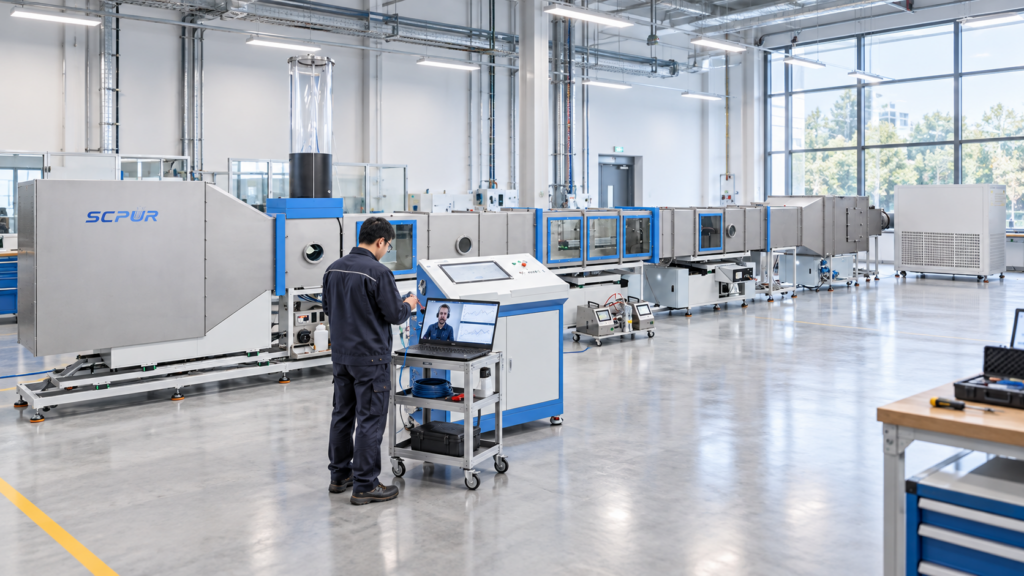
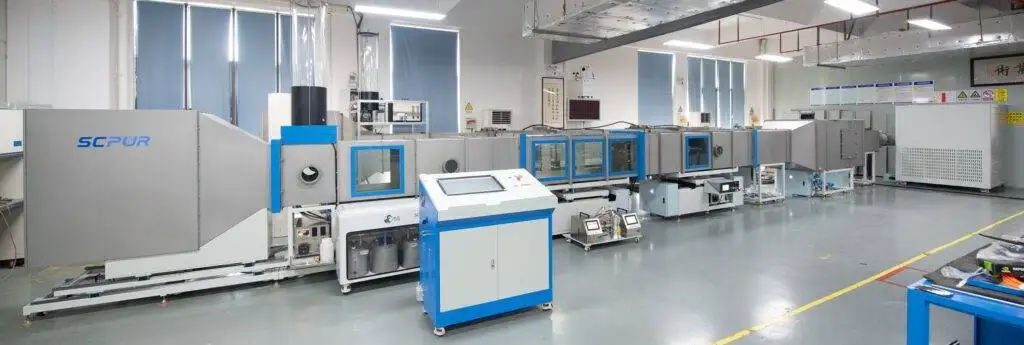
SCPUR provides separate test-system architectures for ISO 29461-1 و ايزو 5011 because the required evidence and measurement chains are different. Defining the result first prevents unnecessary configuration while ensuring that the selected platform can perform the complete required method.
Review the two solution paths: Engine and Turbine Intake Filter Testing Systems
Frequently Asked Questions
Frequently Asked Questions
Can ISO 5011 results be converted to an ISO T class?
Can ISO 5011 results be converted to an ISO T class?
لا. ايزو 5011 gravimetric efficiency and dust-capacity results do not provide the particle-size data and classification procedure required for an ISO T class.
Does ISO 29461-1 test a complete installed gas-turbine intake system?
Does ISO 29461-1 test a complete installed gas-turbine intake system?
Normally, no. ايزو 29461-1 primarily covers individual static filter elements. A complete assembly is only within scope when it meets the qualification criteria for the test arrangement. Installed field-system performance should not be inferred from element data alone.
Does ISO 29461-1 include coastal and high-humidity simulation?
Does ISO 29461-1 include coastal and high-humidity simulation?
جزء 1 is the static-performance method. Fog and mist endurance is addressed in ISO 29461-2, while coastal and offshore salt-and-humidity testing is addressed in ISO 29461-4.
Can one test bench perform both standards?
Can one test bench perform both standards?
Only if it includes and validates both complete measurement chains. ايزو 29461-1 requires the applicable particle-measurement, الهباء الجوي, أخذ العينات, and classification functions. ايزو 5011 requires controlled test-dust feeding, gravimetric collection, وزن, and capacity calculations. Sharing airflow hardware alone is insufficient.
- Engine and Turbine Intake Filter Testing Systems
- نظام اختبار فلتر سحب الهواء SC-5011
- ايزو 29461-1 دليل اختبار مرشح مدخل الهواء
- معايير اختبار فلتر الهواء: دليل عملي
- ايزو 29461-1:2021 – Static filter elements for rotary machinery
- ايزو 5011:2025 – Inlet air-cleaning equipment performance testing
- ايزو 16890-1:2016 – General ventilation filter classification
- ايزو 29463-1:2024 – High-efficiency filter classification
- ايزو 29461-2:2022 – Fog and mist endurance
- ايزو 29461-3:2024 – Mechanical integrity
- ايزو 29461-4:2025 – Coastal and offshore environments
Recommended Test System: