

The Main Difference Is the Required Penetration Level
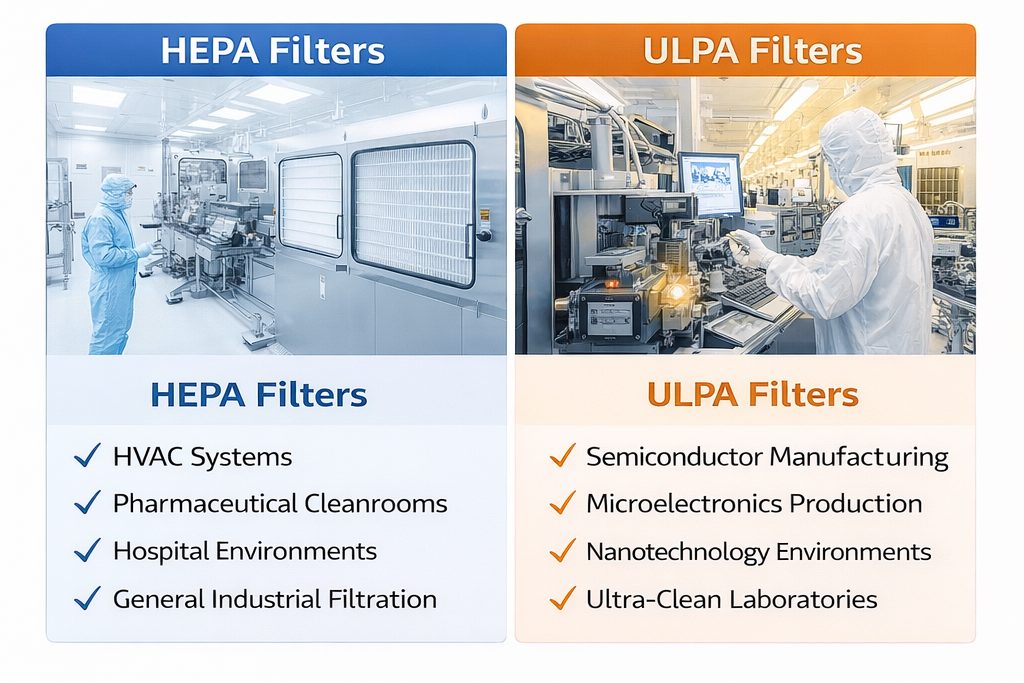
HEPA and ULPA filters are both high-efficiency filters, but ULPA classes permit much lower penetration. Дар зери EN 1822, HEPA filters are classified as H13 and H14, while ULPA filters are classified as U15, U16 and U17. Both groups are evaluated at the most penetrating particle size, ё MPPS.
The commonly quoted expression 99.97 percent at 0.3 micrometres belongs to particular national or customer definitions of HEPA performance. It should not be used as a universal replacement for EN 1822 ё ISO 29463 classification at MPPS.
ДАР 1822 Classification Overview
| Filter group | Синф | Minimum integral efficiency at MPPS |
| HEPA | H13 | 99.95 percent |
| HEPA | H14 | 99.995 percent |
| ULPA | U15 | 99.9995 percent |
| ULPA | U16 | 99.99995 percent |
| ULPA | U17 | 99.999995 percent |
Applicable H and U classes also have local penetration requirements. A complete filter may pass its average integral-efficiency requirement and still fail because one scanned location exceeds the permitted local penetration.
Why the Particle Size Must Not Be Fixed
The MPPS depends on the filter medium, fibre or membrane structure, electrostatic condition and test velocity. It is often within the submicrometre range, but it should not automatically be fixed at 0.3 ё 0.12 микрометр.
For formal EN 1822 ё ISO 29463 тасниф, the report must identify the applicable particle size or MPPS procedure. A fixed 0.3 micrometre test can still be useful for a validated internal production-screening method, but the report must state that limited purpose.
Integral Efficiency and Leak Scanning
Integral efficiency measures the average penetration of the complete filter. Local scanning moves a probe across the downstream face and relevant sealing areas to identify pinholes, миёна зарардида, sealant gaps and assembly defects.
Both results become more difficult to measure as penetration decreases. ULPA testing requires sufficient upstream concentration, very low background counts, controlled dilution, stable airflow, complete probe coverage and enough sampling time to obtain reliable count statistics.
Does ULPA Always Have Higher Pressure Drop
Не. A higher filter class often requires a more efficient medium, but the pressure drop of the finished filter also depends on media permeability, installed media area, pleat depth, pleat spacing, frame design and rated airflow. A well-designed ULPA filter can have a lower pressure drop than a poorly designed HEPA filter at a different airflow.
Efficiency and resistance should therefore be compared at the same airflow and with equivalent filter dimensions. The filter class alone does not determine energy consumption.
Equipment Requirements
| Test task | HEPA requirement | Additional concern for ULPA |
| Андозаи зарраҳо | Detector range suitable for the applicable H class and particle size | Higher sensitivity and reliable submicrometre measurement |
| Upstream challenge | Stable aerosol concentration and representative sampling | Concentration must support extremely low downstream penetration without detector overload |
| Leak scanning | Controlled probe path, speed and coverage | Lower local penetration limits require stronger count statistics and background control |
| Ҳисоботдиҳӣ | Integral result, local result, равиши ҳаво, aerosol and class | MPPS, detector limits, dilution and low-count validity require closer review |
How to Choose the Correct System
- Define the required EN 1822 ё ISO 29463 class and edition.
- Confirm whether the task is media testing, integral efficiency, factory leak scanning or installed-system integrity testing.
- Provide the filter dimensions, geometry, гардиши ҳаво ва ҳадди муқовимат.
- Define the aerosol, диапазони зарраҳо, expected penetration and required detector sensitivity.
- State the production throughput, number of scanning probes and reporting requirements.
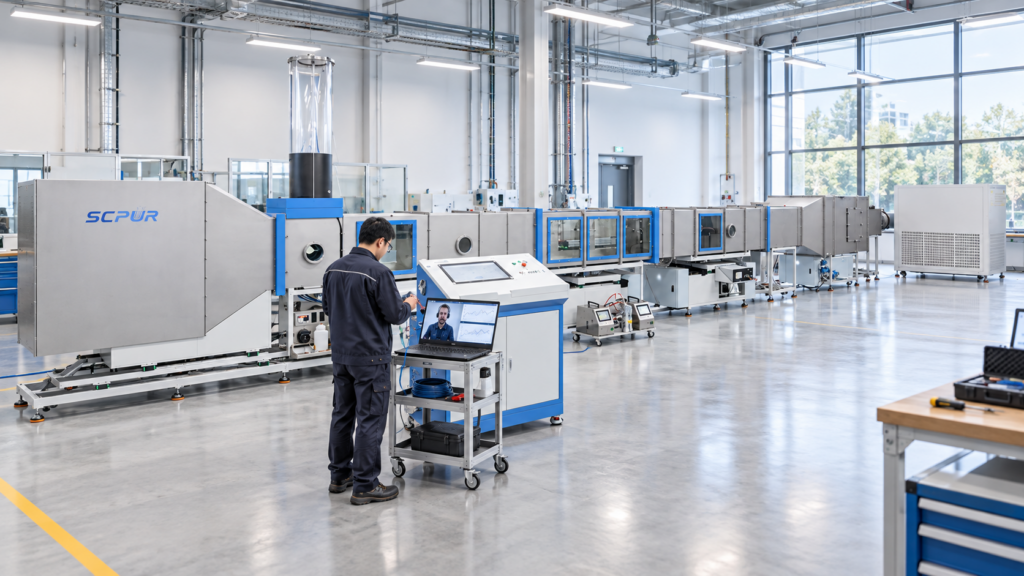
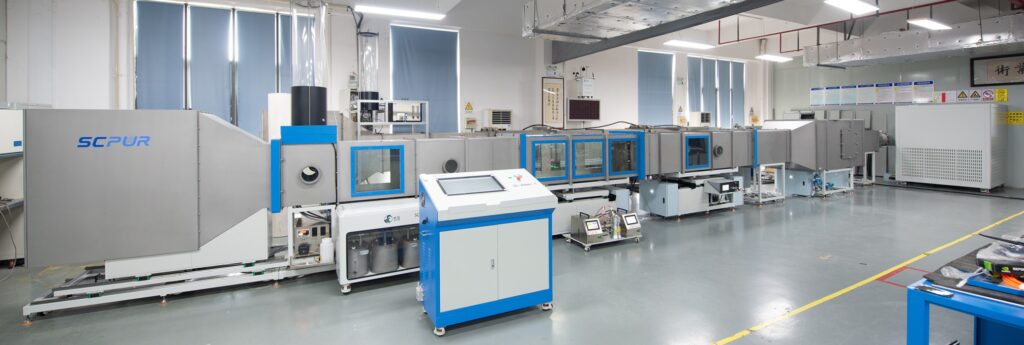
SCPUR SC-L8023 is intended for routine HEPA production testing with a 0.3 micrometre particle-measurement configuration. SC-L8023U extends particle measurement to 0.1 micrometres for MPPS-related HEPA and ULPA applications. The final configuration must be selected from the required class and test method.