

L'efficacité de la filtration et la perte de charge sont deux des caractéristiques de performance les plus importantes d'un filtre à air..
L'efficacité décrit l'efficacité avec laquelle le filtre élimine les particules. La chute de pression décrit la résistance créée lorsque l'air passe à travers le filtre.
Ces résultats doivent être évalués ensemble, mais la relation n’est pas aussi simple : « un rendement plus élevé signifie toujours une chute de pression plus élevée ».
Pourquoi l'efficacité et la chute de pression sont liées
Un filtre doit mettre les particules en suspension dans l'air en contact avec des fibres ou d'autres surfaces de collecte. L'augmentation de la densité des fibres ou la réduction de la taille des pores peuvent améliorer la capture des particules, mais cela peut aussi restreindre le flux d'air.
Cependant, la conception du filtre offre d'autres moyens d'améliorer les performances. Un fabricant peut augmenter la zone médiatique efficace, optimiser la structure des fibres ou améliorer la géométrie des plis pour obtenir une efficacité plus élevée sans la même augmentation de la résistance.
C'est pourquoi deux filtres ayant la même classification ISO ePM peuvent avoir des pertes de charge différentes..
Cinq facteurs qui affectent le résultat
1. Structure du média filtrant
Diamètre des fibres, densité d'emballage, l'épaisseur et les propriétés électrostatiques influencent à la fois l'efficacité et la résistance.
Un milieu mécanique dense et un milieu synthétique chargé peuvent atteindre une efficacité initiale similaire grâce à différents mécanismes de capture. Leurs performances conditionnées peuvent être différentes.
2. Espace Média Efficace
L'augmentation de la quantité de média réduit la vitesse moyenne à travers le média pour le même débit d'air du filtre.
Une vitesse du fluide plus faible peut réduire la chute de pression et modifier l'efficacité fractionnaire.. The effect depends on particle size and the dominant capture mechanism.
3. Pleat Geometry
Pleat height, spacing and stability determine how much of the installed media is used effectively.
Pleats that are too close together can restrict airflow and create uneven flow channels. Deformed pleats may reduce the useful media area even when the total installed media quantity is unchanged.
4. Test Airflow
Pressure drop increases as airflow increases. Fractional efficiency can also change with face velocity and media velocity.
Efficiency and resistance should therefore always be compared at the same airflow, filter size and test condition.
A result measured at a lower airflow cannot be used as though it were obtained at the product’s rated airflow.
5. Chargement de poussière
À mesure que la poussière s'accumule, pressure drop normally increases. L'efficacité peut également changer à mesure que les particules se déposent à l'intérieur ou sur le média filtrant..
Le résultat dépend des médias, poussière, flux d'air et procédure de chargement. Les données de chargement de poussière en laboratoire fournissent une comparaison contrôlée, mais ils ne prédisent pas directement la durée de vie exacte d'un filtre dans chaque installation.
Ce qui doit être mesuré?
Pour une évaluation complète du produit, les fabricants devraient considérer:
- Efficacité fractionnaire par taille de particule
- Efficacité initiale
- Efficacité conditionnée si nécessaire
- Chute de pression au débit d'air nominal
- Courbe de perte de charge sur la plage de débit d'air requise
- Résistance par rapport à la masse de poussière capturée
- Capacité de poussière au point final spécifié
- Construction du filtre et intégrité de l’étanchéité
OIN 16890 utilise des données d'efficacité fractionnelle initiales et conditionnées pour la classification ePM. Le chargement de poussière est un test distinct qui évalue les performances gravimétriques et le développement de la résistance..
Comment comparer deux filtres?
Une comparaison valide nécessite la même chose:
- Norme d'essai
- Dimensions du filtre
- Flux d'air
- Aérosol ou poussière de test
- État de conditionnement
- Chargement du point de terminaison
- Procédure de mesure
Comparer uniquement le pourcentage d’efficacité annoncé peut être trompeur. Un filtre avec une efficacité légèrement supérieure mais une résistance nettement plus élevée n'est peut-être pas la meilleure conception pour le système prévu..
Les fabricants devraient plutôt rechercher une combinaison stable de:
- Performances d’élimination des particules requises
- Résistance initiale acceptable
- Développement contrôlé de résistances
- Capacité de poussière appropriée
- Qualité de production reproductible
Que doit contrôler le système de test?
Des tests précis d’efficacité et de chute de pression nécessitent:
- Flux d'air stable
- Échantillonnage représentatif en amont et en aval
- Concentration uniforme des aérosols
- Gammes de compteurs de particules adaptées
- Corriger la dilution si nécessaire
- Mesure de pression calibrée
- Faible fuite des conduits et des luminaires
- Calcul de données fiable
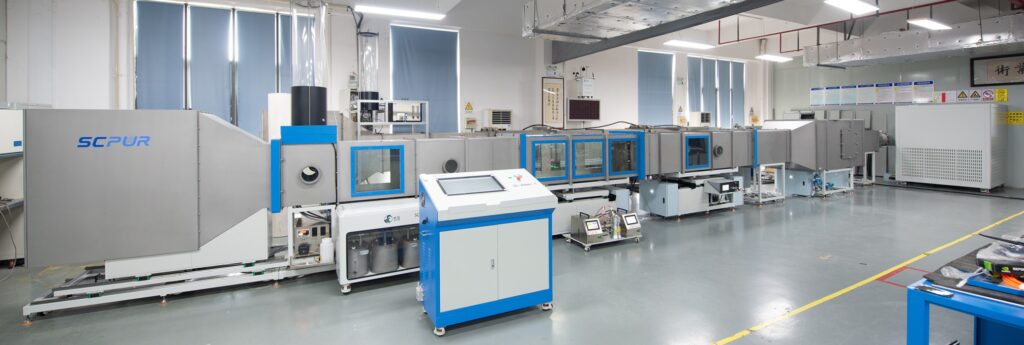
Les systèmes de test SCPUR aident les fabricants de filtres à comparer les médias, conception plissée et construction de filtre complet dans des conditions de flux d'air et de particules contrôlées. Cela permet de baser les décisions de conception sur les performances mesurées plutôt que sur l'efficacité ou la chute de pression uniquement..