

ISO 16890 is the international test and classification system for particulate air filters used in general ventilation. It is commonly applied to panel filters, bag filters, V-bank filters and other filter elements used in HVAC and industrial ventilation systems.
The standard classifies filters according to their calculated efficiency for particulate matter fractions:
- ISO ePM1
- ISO ePM2.5
- ISO ePM10
- ISO Coarse
These classifications provide a consistent basis for comparing filters. However, they should not be interpreted as direct predictions of performance in every building or operating environment.
What Does an ePM Rating Mean?
An ePM rating is calculated from laboratory measurements of fractional efficiency across a range of particle sizes.
During the test, particle concentrations are measured upstream and downstream of the filter. The resulting fractional-efficiency curve is then processed using the standardized reference particle-size distributions defined by ISO 16890.
For example:
ISO ePM1 60%
means that the filter achieved the required calculated efficiency for the ePM1 group under the specified laboratory procedure.
It does not mean that the filter will remove exactly 60% of every real atmospheric PM1 aerosol. Actual service performance also depends on the local particle-size distribution, airflow, humidity, installation sealing, filter loading and maintenance conditions.
ISO Coarse is used for filters that do not reach the applicable ePM10 classification threshold. Their performance is reported using the relevant gravimetric result rather than an ePM1, ePM2.5 or ePM10 classification.
How Is an ISO 16890 Classification Determined?
The classification process includes several related measurements.
1. Airflow and Pressure Drop
The filter is installed in the test duct and operated at the specified airflow. Its resistance is measured under controlled conditions.
Pressure drop should always be considered together with filtration efficiency. Two filters with the same ePM classification may have different resistance characteristics, which can affect system airflow and energy consumption.
2. Initial Fractional Efficiency
A test aerosol is introduced upstream of the filter, and particle concentrations are measured upstream and downstream across the required particle-size range.
This produces an initial fractional-efficiency curve rather than a single efficiency value at one particle size.
3. Filter Conditioning
Some filter media rely partly on electrostatic charge to capture particles. ISO 16890 therefore includes a controlled conditioning procedure to determine the minimum fractional test efficiency after the influence of the charge has been reduced.
This procedure does not reproduce a specified number of months or years of actual service. It is a standardized laboratory method used to make filter comparisons more consistent.
4. ePM Calculation and Classification
The initial and conditioned fractional-efficiency results are processed using the ISO reference particle-size distributions.
The resulting values determine whether the filter qualifies for ISO ePM1, ePM2.5, ePM10 or ISO Coarse classification and the percentage that can be reported.
Is Dust Loading Part of the ePM Classification?
ISO 16890 also includes a dust-loading procedure, but dust loading and ePM classification answer different questions.
The dust-loading test evaluates parameters such as:
- Gravimetric efficiency
- Airflow resistance versus captured dust mass
- Dust capacity at the specified final resistance
These results help manufacturers compare how filters behave as standardized test dust is added. They do not determine the ePM classification and should not be described as a direct simulation of field service life.
How Should ISO 16890 Results Be Used?
A filter should not be selected from its ePM percentage alone. Manufacturers, laboratories and customers should also consider:
- Rated airflow and face velocity
- Initial pressure drop
- Resistance development during loading
- Filter dimensions and sealing arrangement
- Available fan capacity
- Installation and maintenance conditions
- Customer specifications and local ventilation requirements
Application requirements should be defined by the project specification, applicable regulations and ventilation-system design. ISO 16890 itself does not prescribe one universal filter class for every office, hospital, factory or residential building.
When comparing products, use results obtained at comparable airflow and test conditions. An ePM1 result measured for one product configuration should not be compared directly with data obtained at a different airflow, size or test method without reviewing the complete report.
What Testing Capability Does a Manufacturer Need?
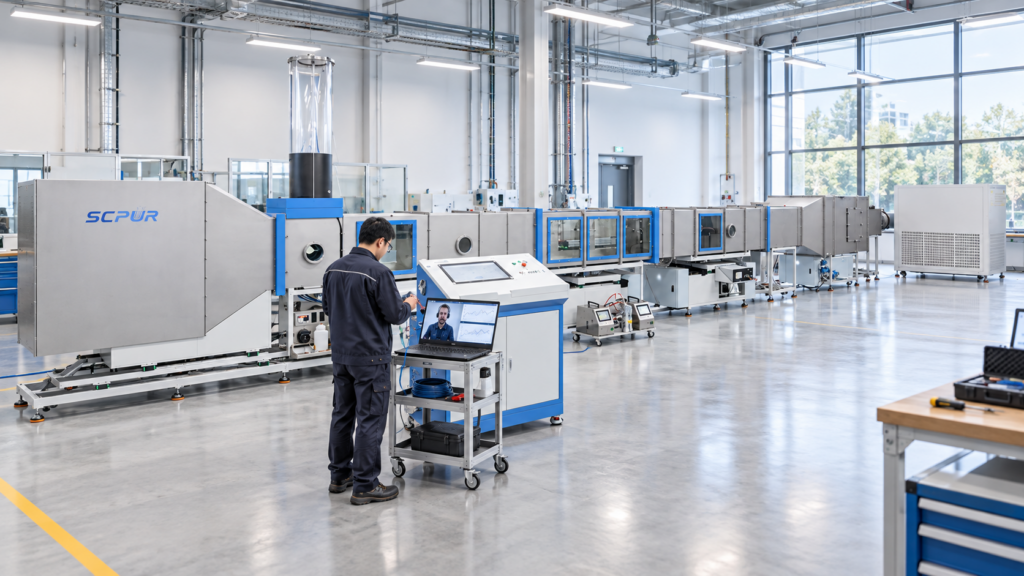
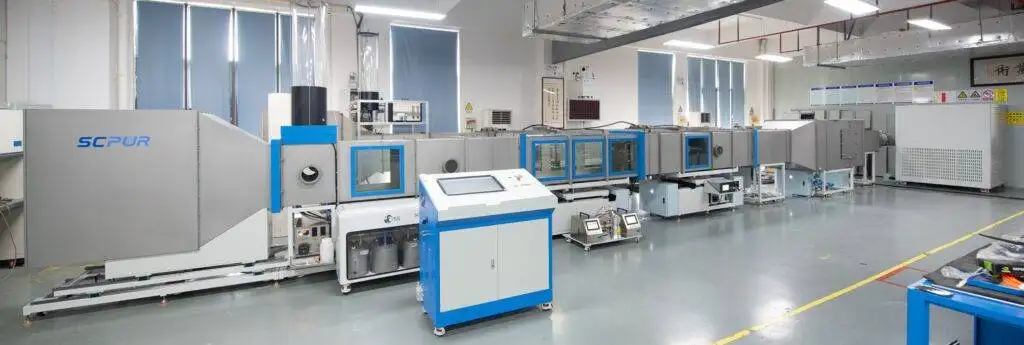
A complete ISO 16890 laboratory may require:
- A test duct with stable airflow control
- Airflow and pressure-drop measurement
- Aerosol generation
- Upstream and downstream particle measurement
- Suitable dilution and sampling arrangements
- A filter-conditioning cabinet
- Dust feeding and weighing equipment
- Automated calculation and report generation
Not every manufacturer needs every module at the beginning. The correct configuration depends on whether the laboratory is intended for product development, routine quality control or complete standard classification.
Before selecting test equipment, define:
- Maximum filter size
- Required airflow and resistance range
- Target ePM groups
- Required parts of the ISO 16890 series
- Expected test volume
- Calibration and reporting requirements
- Possible compatibility with EN 779 or ASHRAE 52.2 methods
SCPUR provides configurable test systems for ISO 16890 efficiency, airflow resistance, conditioning and dust-loading evaluation. Contact us with your filter type, size, rated airflow and required test scope to determine the appropriate laboratory configuration.
Recommended Test System: