

For a HEPA filter manufacturer, the most expensive test system is not always the most appropriate one. The right configuration depends on what the test is expected to prove.
A filter producer in Spain approached SCPUR for a cost-controlled quality solution for H13 filters. The immediate need was to inspect each filter consistently, locate local defects, and retain test records. During the technical review, SCPUR clarified that the proposed 0.3 μm configuration would be defined as an internal production-screening method rather than a complete MPPS classification laboratory.
The important engineering decision was therefore not simply which particle counter to purchase. It was to define the boundary between an internal production test and a formal standards-based classification test.
The Customer's Production Challenge
The Customer’s Production Challenge
The customer needed a more repeatable alternative to visual or qualitative leak inspection. Its production team wanted to:
- scan the complete downstream surface of each filter;
- identify the position of a local penetration increase;
- reduce operator-dependent variation;
- record the result for each tested unit; E
- keep the initial investment proportionate to the actual quality-control requirement.
The customer accepted this defined test boundary for the production application. The selected configuration was not presented as a method for determining the filter medium’s MPPS or issuing third-party EN 1822 classification certificates. This distinction made a more focused production solution possible.
Why a 0.3 μm Counter Was Considered
Why a 0.3 μm Counter Was Considered
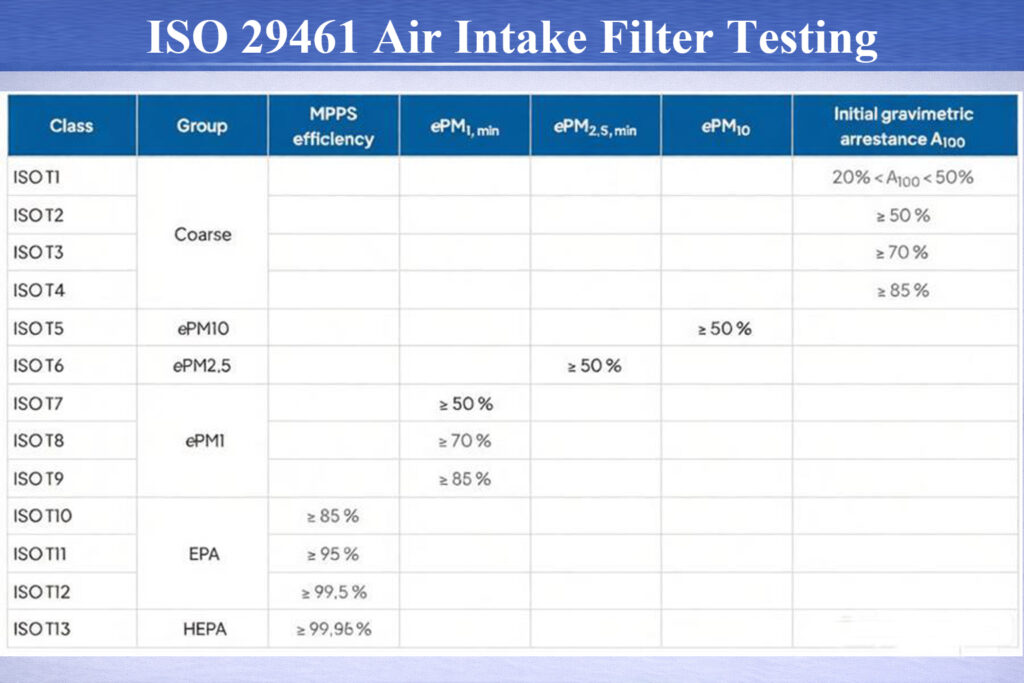
Formal classification under EN 1822 O ISO 29463 is based on filter performance at the most penetrating particle size (MPPS). For micro-glass-fibre media, IL MPPS is often below 0.3 μm, and its exact value depends on the medium and test velocity. A system that measures only at 0.3 μm must therefore not be presented automatically as a complete EN 1822 classification system.
Tuttavia, UN 0.3 μm optical particle counter can still be useful for a manufacturer-defined production screening method when:
- the filter type and test airflow are controlled;
- the aerosol generation and upstream concentration are stable;
- the manufacturer establishes its own acceptance threshold;
- the method is validated against reference samples or a more sensitive reference method; E
- the test report clearly identifies the particle size and procedure used.
In other words, 0.3 μm testing can support internal quality control, process monitoring, and leak screening. It does not by itself establish EN 1822 O ISO 29463 classificazione.
The Configured Solution
The Configured Solution
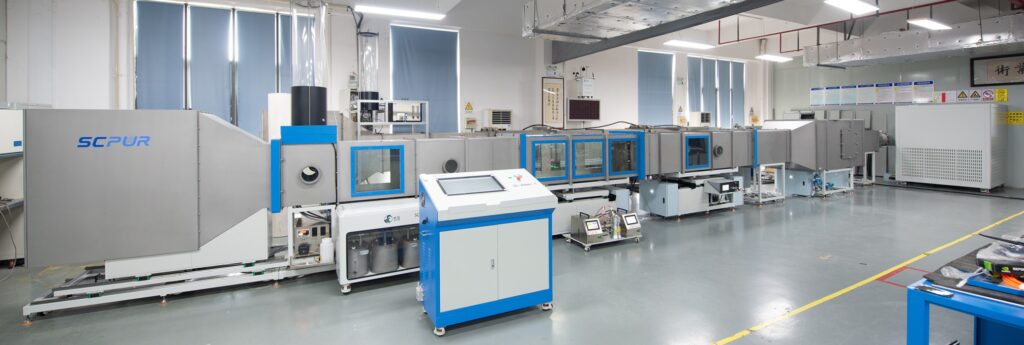
SCPUR proposed an SC-L8023 automatic scanning system configured around the customer’s defined production method. The solution included:
- controlled test airflow and filter clamping;
- stable upstream aerosol challenge;
- automatic downstream surface scanning;
- 0.3 μm particle counting;
- local penetration indication and leak-position mapping; E
- automatic storage of test results.
The motion system keeps the probe path, spacing, and test sequence consistent from one filter to the next. When an abnormal area is detected, the operator can use the recorded position to inspect, repair, and retest the filter.
Validation Before Final Configuration
Validation Before Final Configuration
The customer supplied representative H13 filter samples for testing. Rather than assigning a standards class from the 0.3 μm result, the evaluation focused on the intended production task:
- whether the system could detect known or repeatable local anomalies;
- whether repeated scans produced consistent results;
- whether the selected concentration and sampling settings provided adequate count statistics; E
- whether the test record was useful for production release and repair verification.
This sample-based validation allowed the customer to evaluate the proposed configuration using its own filters before finalizing the equipment.
The Result
The Result
The selected system gave the manufacturer a practical route from qualitative inspection to automated, traceable production screening. It improved consistency and leak localization without incorrectly turning a customer-specific 0.3 μm method into a formal MPPS classification claim.
The solution can also be upgraded when the customer’s requirements change. If future contracts require formal EN 1822 O ISO 29463 test, the particle measurement range, aerosol method, upstream concentration, metodo di scansione, count statistics, and acceptance logic must all be reviewed against the specified filter class and edition of the standard.
What Other Filter Manufacturers Can Learn from This Case
What Other Filter Manufacturers Can Learn from This Case
Before choosing a HEPA filter test system, define the required result first:
- Internal production screening: a validated customer-specific method can be appropriate for routine process control.
- Quantitative leak location: automatic scanning improves coverage, ripetibilità, and repair traceability.
- Formal filter classification: the complete applicable EN 1822 O ISO 29463 procedure must be followed at MPPS.
- Installed-system integrity testing: this is a different task, performed after the filter is installed in its housing or cleanroom system.
SCPUR configures scanning systems around the filter class, size, production rate, required particle range, and the evidence the customer needs the test to provide.
Discuss your filter and test objective with our engineering team: Automatic Scanning Test System SC-L8023/U
Recommended Internal Links
Recommended Internal Links
- Automatic Scanning Test System SC-L8023/U
- Camera bianca HEPA Filter Validation and Leak Testing Solutions
- EN 1822 contro ISO 29463: Classes, Tests and Key Differences
Technical References for Editorial Review
Technical References for Editorial Review