

DANS 1822 et ISO 29463 sont des séries étroitement liées pour tester et classer l'EPA, HEPA, et filtres ULPA. Ils utilisent la même idée de base: déterminer les performances par comptage de particules à la taille de particule la plus pénétrante (MPPS), évaluer l'efficacité globale du filtre, et, si nécessaire, vérifier les performances locales en effectuant des tests d'étanchéité..
Ils ne sont pas, cependant, étiquettes identiques pour une même norme. La différence la plus importante est le système de classification. DANS 1822-1:2019 utilise huit classes européennes familières de E10 à U17. OIN 29463-1:2024 utilise treize classes de l'ISO 05 E à ISO 75 U, y compris les niveaux d'efficacité intermédiaires qui n'ont pas de EN direct 1822 équivalents de classe.
Pour la sélection des équipements et les rapports de tests, “supports EN 1822 et ISO 29463 » ne sont pas suffisamment d'informations. La classe requise, méthode d'essai, débit d'air nominal, Gamme MPPS, aérosol, sensibilité du détecteur, et le format du rapport doit également être défini.
Éditions actuelles couvertes dans cette comparaison
Éditions actuelles couvertes dans cette comparaison
Cet article compare:
- DANS 1822-1:2019, le classement européen actuel, tests de performances, et document de marquage; et
- OIN 29463-1:2024, la troisième édition du document de classification internationale.
La série ISO comprend également ISO 29463-2 pour les besoins de comptage d'aérosols et de particules, OIN 29463-3 pour supports plats, OIN 29463-4 pour fuite d'élément filtrant, et ISO 29463-5:2022 pour l'efficacité des éléments filtrants.
Ce que les deux séries ont en commun
Ce que les deux séries ont en commun
Les deux frameworks sont construits autour de trois tâches de test liées:
- Test du milieu filtrant: déterminer l'efficacité fractionnaire sur une plage de tailles de particules et identifier le MPPS à la vitesse moyenne appropriée.
- Test d'étanchéité des éléments filtrants: évaluer la pénétration locale ou l'absence de fuites inacceptables pour les classes et les méthodes où cela est requis.
- Efficacité du filtre intégré: déterminer l'efficacité globale de l'élément filtrant fini au débit d'air nominal.
Les deux se distinguent dans le groupe E (EPA), Groupe H (HEPA), et Groupe U (ULPA). Les deux classent les performances à MPPS plutôt que de supposer que 0.3 μm est toujours la taille de particule la plus difficile.
La principale différence: Résolution de classification
La principale différence: Résolution de classification
DANS 1822 utilise une série de huit classes. OIN 29463:2024 conserve les niveaux principaux correspondants et ajoute des classes intermédiaires.
| DANS 1822-1:2019 | ISO exacte 29463-1:2024 correspondre | Efficacité globale chez MPPS | Pénétration locale maximale au MPPS |
|---|---|---|---|
| E10 | OIN 05 E | ≥ 85% | Non utilisé pour la classification |
| E11 | OIN 15 E | ≥ 95% | Non utilisé pour la classification |
| E12 | OIN 25 E | ≥ 99.5% | Non utilisé pour la classification |
| H13 | OIN 35 H | ≥ 99.95% | ≤ 0.25% |
| H14 | OIN 45 H | ≥ 99.995% | ≤ 0.025% |
| U15 | OIN 55 U | ≥ 99.9995% | ≤ 0.0025% |
| U16 | OIN 65 U | ≥ 99.99995% | ≤ 0.00025% |
| U17 | OIN 75 U | ≥ 99.999995% | ≤ 0.0001% |
OIN 29463-1:2024 définit en outre l'ISO 10 E, OIN 20 E, OIN 30 E, OIN 40 H, OIN 50 U, OIN 60 U, et ISO 70 U. Ce sont des classes ISO valides, mais ils ne doivent pas être réétiquetés comme étant les EN les plus proches 1822 classe.
Par exemple:
- OIN 40 H a une efficacité globale d’au moins 99.99% chez MPPS. Il se situe entre EN H13 et H14 et n'est pas un filtre EN H14.
- OIN 50 U se situe exactement entre les niveaux équivalents EN ISO 45 H et ISO 55 U. Cela ne crée pas de nouvelle classe EN.
La performance locale n’est pas la même chose que l’efficacité intégrale
La performance locale n’est pas la même chose que l’efficacité intégrale
L'efficacité intégrale fait la moyenne des performances sur toute la surface superficielle du filtre.. L'efficacité locale fait référence aux performances à un emplacement analysé spécifique.
Pour les cours H et U, un filtre peut répondre à ses exigences d'efficacité intégrale tout en ne respectant pas la limite de pénétration locale en raison d'un trou d'épingle, support endommagé, discontinuité du mastic, ou défaut lié au cadre. C'est pourquoi les tests d'efficacité globale et l'analyse des fuites locales sont des tâches distinctes..
Les filtres du groupe E sont différents: dans le cadre de ces systèmes de classification, ils ne sont pas testés contre l'étanchéité à des fins de classification.
Différences dans les règles des méthodes de test d’étanchéité
Différences dans les règles des méthodes de test d’étanchéité
La méthode scan par comptage de particules est la méthode de référence en ISO 29463-4. C'est la méthode requise pour les filtres du groupe U.. OIN 29463 permet également de définir des méthodes alternatives de test d'étanchéité pour les filtres du groupe H lorsque les conditions applicables sont remplies et que la méthode est clairement identifiée.
DANS 1822-1:2019 références ISO 29463 Parties 2 à travers 5 pour les procédures de test détaillées mais applique sa propre classification EN. Le 2019 L'édition EN exclut le test d'étanchéité par balayage du filtre aérosol-photomètre. Les filtres du groupe U sont testés par la méthode de comptage de particules MPPS.
C'est une différence significative. Une affirmation selon laquelle « le test d’étanchéité est le même dans les deux normes » est trop large. Le groupe filtrant et la méthode normative choisie doivent être précisés.
Est 0.3 μm Test suffisant?
Est 0.3 μm Test suffisant?
Pas automatiquement. Les normes classent les filtres chez MPPS. OIN 29463 note que le MPPS pour les supports en microfibres de verre se situe souvent dans la plage approximative de 0.12 μm à 0.25 μm, tandis que la membrane et les médias chargés nécessitent une considération supplémentaire.
UN 0.3 Le canal de particules µm peut être utile pour une méthode de contrôle qualité interne validée, mais il ne doit pas être présenté comme formel FR 1822 ou ISO 29463 classification à moins que la procédure applicable complète et la mesure MPPS requise ne soient satisfaites.
Comment la différence affecte l’équipement de test
Comment la différence affecte l’équipement de test
Un système de test approprié n’est pas défini uniquement par sa plage de débit d’air. Les questions clés sur la configuration incluent:
- Quelle classe EN ou ISO doit être déclarée?
- La tâche consiste-t-elle à déterminer le MPPS du média filtrant, efficacité intégrale du filtre fini, analyse de fuite locale, ou les trois?
- Quel est le débit d'air nominal et la plage de tailles de filtre?
- L'aérosol de test est-il monodispersé, quasi-monodispersé, ou polydispersé?
- Quelle plage de granulométrie et quelle concentration le détecteur doit-il mesurer?
- La contre-sensibilité est-elle suffisante pour la pénétration locale et intégrale attendue?
- Comment la couverture de numérisation, géométrie de la sonde, vitesse, temps d'échantillonnage, et les statistiques de comptage soient contrôlées?
- Quelle méthode alternative de fuite, le cas échéant, est autorisé par le contrat et la norme?
La sensibilité requise augmente considérablement de H13 à U17. Un système adapté à un test de production H13 n'est pas automatiquement adéquat pour U16 ou U17.
Quelle norme un fabricant doit-il spécifier?
Quelle norme un fabricant doit-il spécifier?
Utiliser la norme mentionnée dans le contrat client, exigence réglementaire, ou marché cible. Si un fabricant sert à la fois des clients européens et internationaux, le rapport d'essai peut inclure les deux classifications uniquement lorsqu'une cartographie exacte existe et que les procédures applicables ont été respectées.
Ne convertissez pas une classe ISO intermédiaire en une classe EN non officielle. Plutôt, rapport:
- la norme complète et l'édition;
- la classe de filtre exactement telle que définie;
- le débit d'air nominal;
- le test aérosol et MPPS;
- l'efficacité intégrale ou la pénétration;
- la méthode locale de test d'étanchéité et la limite d'acceptation; et
- toute dérogation convenue ou méthode de production spécifique au client.
Résumé pratique
Résumé pratique
- DANS 1822 et ISO 29463 partager les principes de comptage de particules basés sur MPPS.
- DANS 1822-1:2019 a huit classes; OIN 29463-1:2024 a treize.
- Seules les classes ISO spécifiques correspondent exactement à E10 – E12, H13-H14, et U15-U17.
- L'efficacité intégrale et la pénétration locale sont des résultats d'acceptation différents.
- Les filtres du groupe E ne sont pas testés contre les fuites pour la classification.
- Les options de méthode pour les filtres des groupes H et U doivent être vérifiées plutôt que supposées.
- UN 0.3 Le test de production μm n’est pas automatiquement un test de classification MPPS.
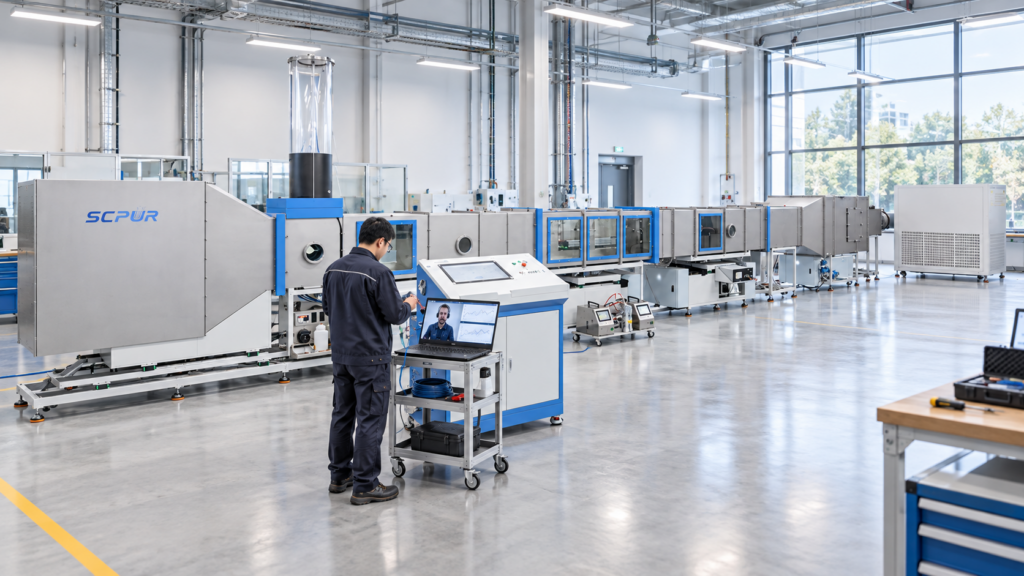
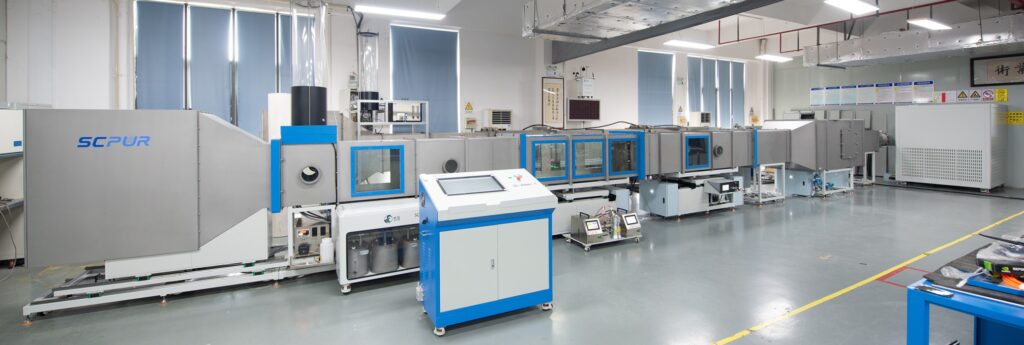
SCPUR configure les systèmes d'analyse automatique des filtres en fonction de la classe requise, portée du détecteur, dimensions du filtre, flux d'air, méthode aérosol, et flux de production. Voir le Système de test de numérisation automatique SC-L8023/U pour l'aperçu de la plateforme.
- Comprendre FR 1822 Test du filtre HEPA
- Système de test de numérisation automatique SC-L8023/U
- Test de fuite du filtre HEPA: Analyse d'usine et test d'intégrité du système installé
- Solutions de validation de filtres HEPA et de test de fuite pour salles blanches
- BS EN 1822-1:2019 — Classement, tests de performances et marquage
- OIN 29463-1:2024 — Classement, performance, tests et marquage
- OIN 29463-2:2011 — Production d'aérosols, équipements de mesure et statistiques de comptage de particules
- OIN 29463-4:2011 — Méthode d'essai pour déterminer les fuites des éléments filtrants, méthode de numérisation
- OIN 29463-5:2022 — Méthode d'essai pour les éléments filtrants