

IN 1822 en ISO 29463 are closely related series for testing and classifying EPA, HEPA, en ULPA-filters. They use the same core idea: determine performance by particle counting at the most penetrating particle size (MPPS), evaluate overall filter efficiency, and—where required—verify local performance by leak testing.
They are not, however, identical labels for the same standard. The most important difference is the classification system. IN 1822-1:2019 uses eight familiar European classes from E10 to U17. ISO 29463-1:2024 uses thirteen classes from ISO 05 E to ISO 75 U, including intermediate efficiency levels that do not have direct EN 1822 class equivalents.
For equipment selection and test reporting, “supports EN 1822 and ISO 29463” is not enough information. The required class, test methode, nominale luchtstroom, MPPS range, aërosol, detector sensitivity, and report format must also be defined.
Current Editions Covered in This Comparison
Current Editions Covered in This Comparison
This article compares:
- IN 1822-1:2019, the current European classification, performance-testing, and marking document; En
- ISO 29463-1:2024, the third edition of the international classification document.
The ISO series also includes ISO 29463-2 for aerosol and particle-counting requirements, ISO 29463-3 for flat-sheet media, ISO 29463-4 for filter-element leakage, en ISO 29463-5:2022 for filter-element efficiency.
What the Two Series Have in Common
What the Two Series Have in Common
Both frameworks are built around three related test tasks:
- Filter-medium testing: determine fractional efficiency over a particle-size range and identify the MPPS at the relevant medium velocity.
- Filter-element leak testing: assess local penetration or the absence of unacceptable leaks for the classes and methods where this is required.
- Integral filter efficiency: determine the overall efficiency of the finished filter element at the nominal airflow.
Both distinguish among Group E (EPA), Groep H (HEPA), and Group U (ULPA). Both classify performance at MPPS rather than assuming that 0.3 μm is always the most difficult particle size.
The Main Difference: Classification Resolution
The Main Difference: Classification Resolution
IN 1822 uses one series of eight classes. ISO 29463:2024 retains the corresponding main levels and adds intermediate classes.
| IN 1822-1:2019 | Exact ISO 29463-1:2024 match | Algemene efficiëntie bij MPPS | Maximum local penetration at MPPS |
|---|---|---|---|
| E10 | ISO 05 E | ≥ 85% | Niet gebruikt voor classificatie |
| E11 | ISO 15 E | ≥ 95% | Niet gebruikt voor classificatie |
| E12 | ISO 25 E | ≥ 99.5% | Niet gebruikt voor classificatie |
| H13 | ISO 35 H | ≥ 99.95% | ≤ 0.25% |
| H14 | ISO 45 H | ≥ 99.995% | ≤ 0.025% |
| U15 | ISO 55 U | ≥ 99.9995% | ≤ 0.0025% |
| U16 | ISO 65 U | ≥ 99.99995% | ≤ 0.00025% |
| U17 | ISO 75 U | ≥ 99.999995% | ≤ 0.0001% |
ISO 29463-1:2024 additionally defines ISO 10 E, ISO 20 E, ISO 30 E, ISO 40 H, ISO 50 U, ISO 60 U, en ISO 70 U. These are valid ISO classes, but they should not be relabelled as the nearest EN 1822 klas.
Bijvoorbeeld:
- ISO 40 H has an overall efficiency of at least 99.99% at MPPS. It sits between EN H13 and H14 and is not an EN H14 filter.
- ISO 50 U sits between the exact EN-equivalent levels ISO 45 H and ISO 55 U. It does not create a new EN class.
Local Performance Is Not the Same as Integral Efficiency
Local Performance Is Not the Same as Integral Efficiency
Integral efficiency averages performance across the complete superficial face area of the filter. Local efficiency refers to performance at a specific scanned location.
For H and U classes, a filter can meet its integral efficiency requirement yet fail the local penetration limit because of a pinhole, beschadigd medium, sealant discontinuity, or frame-related defect. This is why overall efficiency testing and local leak scanning are separate tasks.
Group E filters are different: under these classification systems, they are not leak-tested for classification purposes.
Differences in Leak-Test Method Rules
Differences in Leak-Test Method Rules
The particle-counting scan method is the reference method in ISO 29463-4. It is the required method for Group U filters. ISO 29463 also permits defined alternative leak-test methods for Group H filters when the applicable conditions are met and the method is clearly identified.
IN 1822-1:2019 references ISO 29463 Onderdelen 2 through 5 for the detailed test procedures but applies its own EN classification. De 2019 EN edition excludes the aerosol-photometer filter scan leak test. Group U filters are tested by the MPPS particle-counting scan method.
This is a meaningful difference. A statement that “the leak test is the same in both standards” is too broad. The filter group and the selected normative method must be stated.
Is 0.3 μm Testing Sufficient?
Is 0.3 μm Testing Sufficient?
Not automatically. The standards classify filters at MPPS. ISO 29463 notes that the MPPS for micro-glass-fibre media is often in the approximate range of 0.12 μm to 0.25 μm, while membrane and charged media require additional consideration.
A 0.3 μm particle channel can be useful for a validated internal quality-control method, but it must not be presented as formal EN 1822 of ISO 29463 classification unless the complete applicable procedure and required MPPS measurement are satisfied.
How the Difference Affects Test Equipment
How the Difference Affects Test Equipment
A suitable test system is defined by more than its airflow range. Key configuration questions include:
- Which EN or ISO class must be reported?
- Is the task filter-media MPPS determination, finished-filter integral efficiency, local leak scanning, or all three?
- What is the nominal airflow and filter size range?
- Is the test aerosol monodisperse, quasi-monodisperse, or polydisperse?
- What particle-size range and concentration must the detector measure?
- Is the counter sensitivity sufficient for the expected local and integral penetration?
- How will scanning coverage, probe geometry, speed, bemonsteringstijd, and counting statistics be controlled?
- Which alternative leak method, if any, is permitted by the contract and standard?
The required sensitivity increases substantially from H13 through U17. A system suitable for a production H13 test is not automatically adequate for U16 or U17.
Which Standard Should a Manufacturer Specify?
Which Standard Should a Manufacturer Specify?
Use the standard named in the customer contract, regulatory requirement, or target market. If a manufacturer serves both European and international customers, the test report can include both classifications only where an exact mapping exists and the applicable procedures have been satisfied.
Do not convert an intermediate ISO class into an unofficial EN class. In plaats van, report:
- the full standard and edition;
- the filter class exactly as defined;
- the nominal airflow;
- the test aerosol and MPPS;
- the integral efficiency or penetration;
- the local leak-test method and acceptance limit; En
- any agreed deviation or customer-specific production method.
Practical Summary
Practical Summary
- IN 1822 en ISO 29463 share MPPS-based particle-counting principles.
- IN 1822-1:2019 has eight classes; ISO 29463-1:2024 has thirteen.
- Only specific ISO classes map exactly to E10–E12, H13–H14, and U15–U17.
- Integral efficiency and local penetration are different acceptance results.
- Group E filters are not leak-tested for classification.
- Method options for Group H and U filters must be checked rather than assumed.
- A 0.3 μm production test is not automatically an MPPS classification test.
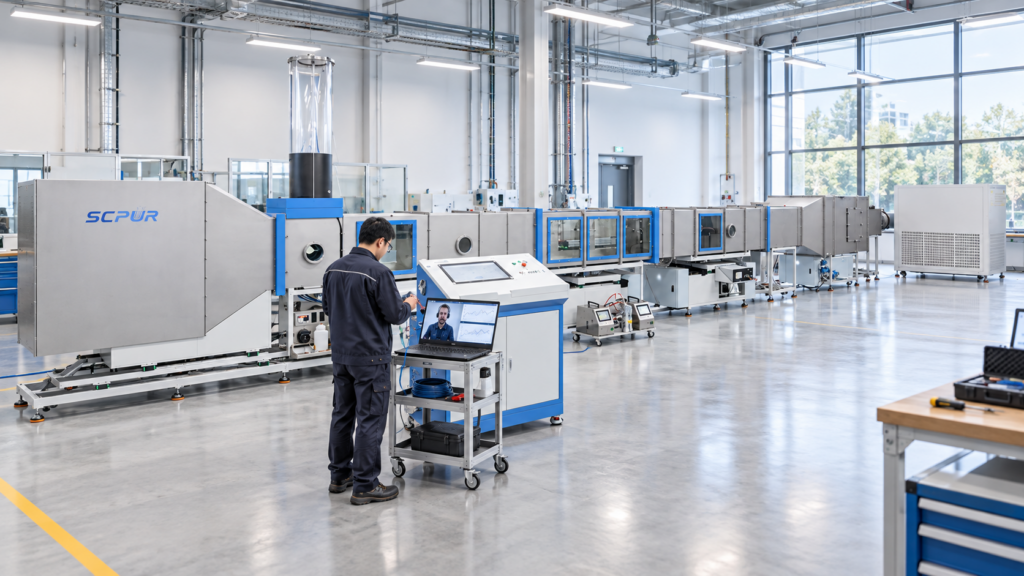
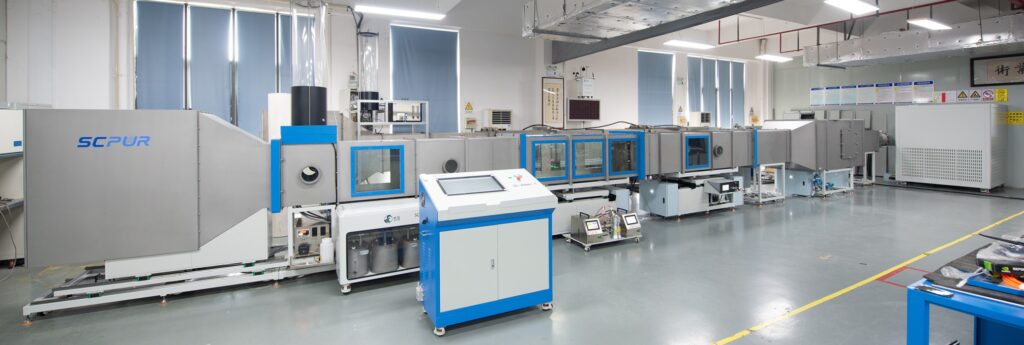
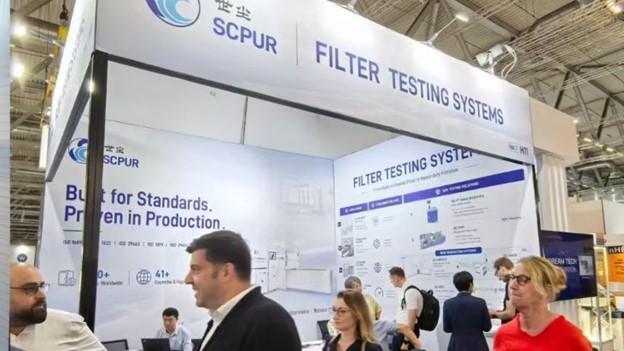
SCPUR configures automatic filter scanning systems according to the required class, detector range, filter dimensions, luchtstroom, aerosol-methode, and production workflow. See the SC-L8023/U Automatisch scantestsysteem for the platform overview.
- NL begrijpen 1822 HEPA-filtertesten
- Automatisch scantestsysteem SC-L8023/U
- HEPA-filter lektest: Fabrieksscan versus geïnstalleerde systeemintegriteitstest
- Cleanroom HEPA-filtervalidatie en lektestoplossingen
- BS EN 1822-1:2019 — Classificatie, prestatietests en markering
- ISO 29463-1:2024 — Classificatie, prestatie, testen en markeren
- ISO 29463-2:2011 — Aërosolproductie, meetapparatuur en deeltjestelstatistieken
- ISO 29463-4:2011 — Testmethode voor het vaststellen van lekkage van filterelementen, scanmethode
- ISO 29463-5:2022 — Testmethode voor filterelementen